
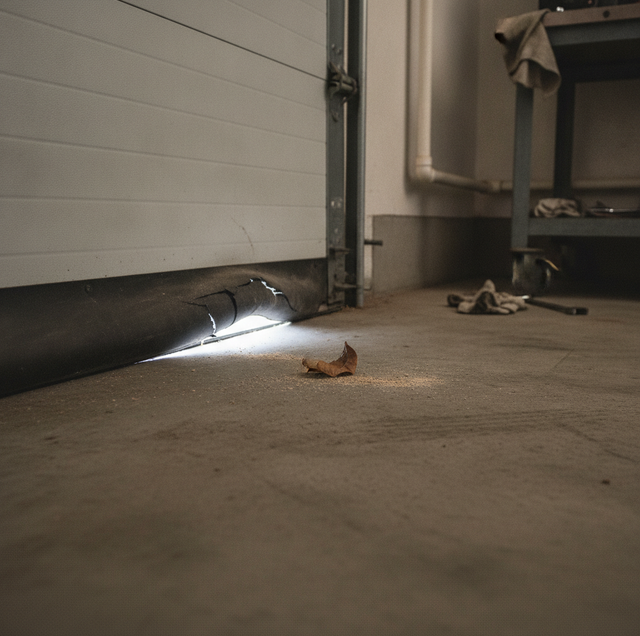
Quick Answer: The most common reason for a gap under a closed garage door is a worn or hardened bottom weather seal (the astragal) that no longer compresses against the floor. Other causes include a settled or uneven concrete slab, an opener down-limit set too high, so the door stops short, a door slightly off its tracks, or a spring or cable imbalance that leaves one corner high. A uniform thin gap usually means the seal; a gap at one spot usually means the floor or hardware.
A garage door that closes all the way should press flat against the floor and leave no daylight underneath. When you start finding a thin line of light, a drift of dust, a trail of leaves, or a puddle after a storm along the bottom edge, the door is no longer sealing. That gap is not random. It points to a specific mechanical cause, and once you can read the tells, you can tell whether it's a quick fix you can do yourself or a job that needs a technician.
Most gaps trace back to the rubber strip on the very bottom of the door, but a few other culprits look similar at first glance and need a completely different repair.
What the Bottom of the Door Is Supposed to Do
The bottom edge of almost every sectional garage door carries a flexible rubber or vinyl strip called the astragal, or bottom weather seal. It sits in an aluminum retainer channel that runs the full width of the door. When the door reaches the floor, the door's own weight squashes that strip flat, and the rubber spreads out to fill any small unevenness in the concrete. That compression is what actually creates the seal.
Think of it like the rubber gasket around a refrigerator door: the rigid door can't conform to anything, so a soft strip does the conforming for it, pressing into place and closing the gap. A garage door works the same way: when that strip stops doing its job, or the door never reaches the floor, the seal opens, and everything it was blocking starts coming in.
The Common Causes, and How to Read Each One
This is the number one cause by a wide margin. Rubber and vinyl seals age. They take a set from years of compression, they crack, and they harden until they can no longer flatten out under the door's weight. A seal that has gone stiff still looks like it's touching the floor, but it isn't spreading to fill the gaps, so thin gaps appear along the length of the door.
Sustained heat and ultraviolet exposure speed this up. UV breaks down the plasticizers that keep the rubber flexible, and long stretches of high temperature bake the strip until it splits, so in a hot, sunny climate, a bottom seal can harden and crack years earlier than in a mild one.
The tell: the gap is fairly uniform across the whole width, thin and even, and when you look at the strip itself, you find cracks, splits, a flattened profile that no longer curls down, or rubber that feels brittle instead of pliable. Press on it and it stays put rather than springing back.
An Uneven, Cracked, or Settled Concrete Floor
Concrete settles over time, especially near the edges of a garage, and it can crack and drop on one side. When the floor is no longer flat where the door lands, the door hits a low spot and can't close the gap, even though the seal is fine.
The tell: the gap is not uniform. It's concentrated at one end, or in the middle, and it follows the contour of the concrete. You can often see the low point in the slab itself. The seal on the rest of the door touches down normally; it's only the section over the dip that leaves daylight.
The Opener's Down-Travel Limit Set Too High
Automatic openers have a down-travel (or down-limit) setting that tells the opener how far to drive the door before it stops. If that limit is set too high, the opener halts the door a fraction before it reaches the floor. The door looks closed, but it's hanging short of the seal ever touching down.
The tell: watch the door close. If it visibly stops before the bottom seal contacts the concrete, and the seal itself looks intact, the limit is the likely cause. Sometimes you can nudge the door down another inch by hand after it stops, which confirms it isn't traveling its full distance.
A Door That's Off-Track or a Bent Bottom Section
If the door has slipped slightly off its track on one side, or the bottom section has been bent (a common result of a bump from a vehicle), the bottom edge no longer sits parallel to the floor. One area rides high and won't seat.
The tell: look at the bottom edge against the floor line. If it's not parallel, or you can see the rollers sitting oddly in the track, the door geometry is off, rather than the seal or floor.
A Spring or Cable Imbalance Leaving One Corner High
The lift cables and springs carry the door's weight evenly on both sides. If a lift cable has stretched or frayed, or a spring on one side has weakened or broken, that side can hang differently, and one bottom corner won't press down fully. The result is a wedge-shaped gap that's widest at one corner.
The tell: the gap is worse at one corner and tapers toward the other. You may also notice the door looks slightly crooked as it closes, or one side moves faster than the other.
Missing or Worn Side and Top Weatherstripping
The astragal seals the bottom, but the jamb seal (the weatherstripping along the two sides and the top of the door frame) blocks dust and water at the edges. If that stripping is torn, brittle, or missing, grit and water get in around the perimeter even when the bottom is sealing fine. This isn't a floor gap, but people often lump it in when they're tracking down where the dust is coming from.
How to Tell These Apart in Practice
The fastest way to narrow it down is to look at where the gap is and what shape it takes.
- A uniform, thin gap along most of the width, with cracked or hardened rubber, points to the bottom seal.
- A gap concentrated at one spot that follows the concrete points to a settled or uneven floor.
- A door that visibly stops before the seal reaches the floor points to the opener's down-limit.
- A wedge-shaped gap, widest at one corner, points to a cable or spring imbalance, or an off-track or bent section.
Do these checks with the door fully closed, and unplug the opener before inspecting the seal or hardware so nothing moves while you're looking. If you find more than one at once (a hardened seal on top of a low slab, say), you may need more than one fix.
What Each Fix Involves
Replacing the bottom seal is the most common repair and is friendly to a careful DIYer. The old astragal slides out of the aluminum retainer channel at the bottom of the door, and a new strip of the matching profile slides back in. The catch is matching the hardware: retainers come in different styles (a T-style channel with two slots, or a single bead channel), and the new seal has to match both the retainer type and the door's width. Get the wrong profile, and it won't seat in the channel.
For an uneven or cracked slab, a garage-door threshold seal is often the better answer than fighting the floor. A threshold is a rubber strip that bonds to the concrete itself, and the door closes down against it. Because it builds up a slight ridge on the floor, it bridges low spots the door can't reach and gives a firm surface to seal against. It's also good insurance against driving rain and blowing dust. The one caveat: a threshold seals from both directions, so if your floor slopes inward, it can trap water inside the garage rather than letting it drain out. On a floor that pitches toward the door, it works beautifully; on one that pitches inward, think it through first.
Adjusting the opener's down-travel limit is usually a matter of turning an adjustment screw or holding a button on the opener head, per that model's procedure. The important part is safety: when you change the down-limit, you also have to make sure the door's closing force is still set correctly so it reverses on contact with an obstruction. Never crank the force up to muscle the door past a real obstruction; that defeats the safety reversal that keeps a person or pet from being trapped.
Track, spring, and cable problems are a different category. The springs on a garage door hold an enormous amount of stored energy, and cables under load can whip if released improperly. Adjusting or replacing springs and cables, resetting a door on its tracks, or straightening a bent bottom section is work for a trained technician with the right tools. Never attempt to loosen, adjust, or remove a spring yourself.
Why a Good Bottom Seal Earns Its Keep
A sealed bottom edge does real work against the outdoors. Wind-driven dust and grit, the fine sediment that a strong dust storm pushes across everything, blowing leaves, crawling pests, and storm water all try to get in under the door, and a compressed seal is the barrier that stops them. The demands run both ways through the year: sustained heat and UV harden and crack the rubber over the dry months, while wind-blown grit and heavy seasonal rain test the seal from the outside. A strip that's still soft enough to flatten and spread is what keeps the garage clean and dry in either condition.
Frequently Asked Questions
Look at the gap's shape. A bad seal produces a fairly uniform, thin gap across most of the door's width, and the rubber itself will show cracks, splits, or a hardened, flattened profile that no longer springs back when you press it. A floor problem produces a gap only at one end or in the middle, and that gap follows the contour of the concrete rather than running evenly. If you can see a low or cracked spot in the slab right where the daylight shows, the floor has settled, and the seal is likely fine.
Often, yes. The bottom seal slides into an aluminum retainer channel mounted on the bottom edge of the door, and a new strip slides in the same way once you pull the old one out. The part that trips people up is matching the hardware. Retainers come in different styles, most commonly a T-style channel with two slots that grip a beaded seal, versus a single-bead channel, and you have to buy the seal that fits your retainer type as well as your exact door width. Bring a short sample of the old seal or note the channel style before you buy, so the new profile actually seats in the groove.
A threshold seal is a rubber strip bonded directly to the garage floor, forming a low ridge that the door closes down against. It's the right choice for an uneven or settled slab because it bridges low spots that the door alone can't reach, and it's excellent at holding back driving rain and blown dust because the door presses into a firm, continuous surface. The one thing to check first is which way your floor slopes: because a threshold blocks water from both directions, a floor that pitches inward can trap rain inside the garage instead of draining it out. On a slab that pitches toward the driveway, a threshold is close to ideal.
A gap that's worst at one corner and tapers toward the other usually means that side of the door is hanging slightly high. The common reasons are a lift cable that has stretched on that side, a weak or broken spring throwing the balance off, or the door sitting slightly off its track so one corner never seats. You may also notice the door looks a little crooked as it closes or that one side lags behind the other. Because the fix involves cables, springs, or tracks under load, this is one to hand to a technician rather than adjust yourself.
Yes. The opener's down-travel limit controls how far the door drives before it stops, and if that limit is set too high, the door halts just short of the floor with the seal never touching down. Adjusting the down-limit so the door travels its full distance closes the gap. The important companion check is the closing force: after changing the limit, the door still has to reverse when it meets resistance, so the force setting must stay within a safe range and never be increased to force the door past a real obstruction.
A fully compressed bottom seal, paired with intact weatherstripping along the sides and top of the frame, blocks most crawling pests and the fine grit that a dust storm drives under the door. The keyword is fully. The seal has to compress along the entire width, with no cracked sections or low spots where the strip has hardened, and the side and top jamb seals have to be intact too, since pests and blown dust exploit the edges as readily as the bottom. A seal that touches down only in places leaves exactly the gaps that a determined scorpion or a strong gust will find.
Book a bottom-seal or threshold repair with a technician who inspects the whole door — so dust, water, and pests stop getting in. Phoenician Garage Door & Repair serves Phoenix and the Valley. ROC #316471. Call (602) 610-0112.
