
Garage Door Remote Not Working? 7 Fixes to Try
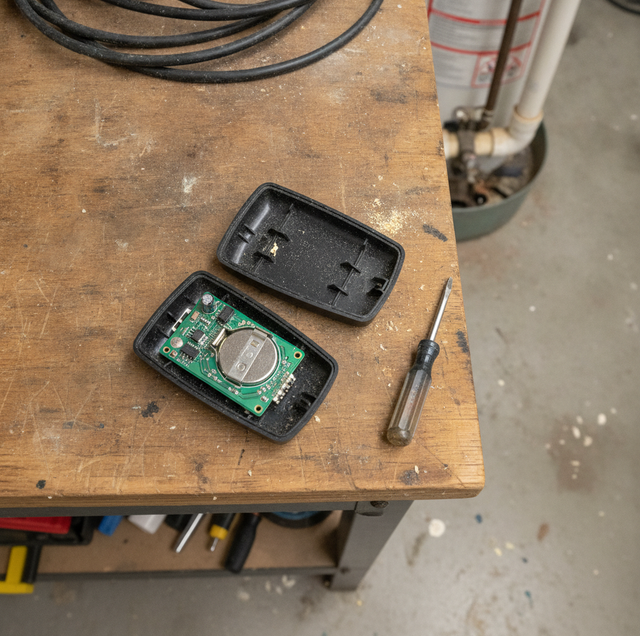
Quick Answer: A remote that suddenly quits is usually a dead battery, a remote that lost its pairing to the opener, a curled-up antenna, radio interference from LED bulbs, or the opener sitting in lock mode. If the wall button still opens the door, the problem is on the remote side. If nothing works at all, look at the power and the trolley release, not the remote.
Start by Asking One Question: Does the Wall Button Work?
Before you touch anything, walk into the garage and press the wall-mounted button. The answer splits the whole problem in half.
If the wall button opens and closes the door normally, but your handheld remotes do nothing, the opener, motor, springs, and door are all fine. The break is somewhere between your remote and the opener's receiver: a dead battery, lost programming, interference, a poor antenna, or a lock setting. These are the causes most homeowners can handle without tools.
If nothing works, not the wall button and not any remote, the problem is not the remote at all. Now you are looking at power reaching the opener, the logic board inside the motor head, or whether the door has been physically disconnected from the trolley. That is a different investigation, covered further down.
Running this one test first saves you from swapping batteries for an hour when the real issue is a tripped outlet.
The Remote Side: When the Wall Button Works but the Remote Doesn't
A Dead or Weak Battery
This is the most common cause by a wide margin, and the easiest to rule out. Garage remote batteries, usually a flat coin cell like a CR2032 or a small A23, fade gradually. Range shrinks first, so you have to stand closer and closer, then one day it quits. Pop the remote open, note the battery type printed on the old cell, and drop in a fresh one. If a new battery brings it back, you are done.
The Remote Lost Its Pairing
Openers and remotes talk using a rolling code that both sides have to agree on. After a power outage, a battery change, or an electrical surge, a remote can fall out of sync with the opener even though the battery is perfectly good. The remote sends a valid signal, but the opener no longer recognizes it as authorized. The cure is reprogramming, sometimes called re-pairing or teaching the remote to the opener. It takes under a minute once you know where the learn button is.
A Curled or Damaged Antenna
Look up at the motor head, and you will see a thin wire, often just a few inches long, hanging straight down. That is the receiver antenna, and its length and position matter more than people expect. If it has been cut short, wrapped around itself, or tucked up over the motor during a cleanup, the opener's reception drops, and your effective range collapses. Letting it hang free and straight down is the fix, and it costs nothing.
Radio Interference
Your opener listens on a specific radio frequency, and other devices can crowd that channel. The surprise culprit is often the LED bulbs screwed into the opener itself. Many cheaper LEDs throw off radio noise that sits right on the opener's frequency and drowns out the remote, which is why your range might drop the same week you changed a burned-out bulb. Nearby routers, security cameras, or even a neighbor's equipment can do the same. Swapping the opener's bulbs for ones rated for garage-door use is the usual cure.
Lock or Vacation Mode
Most wall consoles have a button labeled lock, or a small slide switch marked vacation. Its entire job is to disable every handheld remote, so no one can open the door with a spare while you are away. It is easy to bump without noticing. If the wall button works fine and every remote is dead at once, this lockout is a prime suspect. Press or toggle it off and try again.
You're Simply Out of Range, or the Remote Is Cracked
Radio range is finite, and a remote that has been dropped one too many times can crack a solder joint inside. If a single remote fails while another still works, the failed unit is the problem, not the opener. If none work from the driveway but all work from ten feet away, you are looking at a range issue, which loops back to the antenna and interference above.
Homeowner-Safe Steps You Can Do Today
None of the following requires touching a spring or a cable, and none of them puts you near the parts that store dangerous tension.
- Replace the remote battery with the matching type and check that it seats fully.
- Reprogram the remote to the opener using the learn button and your manual.
- Confirm the antenna wire hangs freely, straight down, uncut and uncurled.
- Swap the opener's LED bulbs for bulbs rated for garage-door openers.
- Check the wall console for a lock or vacation switch and turn it off.
- Confirm the opener is plugged in and the outlet has live power.
- If the door came off its track motion, re-engage the trolley (see the safety note).
Work through them in that order. Each one rules out a cause, and most doors are back in service before you reach the bottom of the list.
When Nothing Works at All
If the wall button is as dead as the remote, stop thinking about radio signals. The opener is not getting the command from any source, which points to power or a mechanical disconnect.
First, check that the opener is plugged in. Ceiling outlets get bumped by ladders, and plugs work loose over time. Second, check the outlet itself. Many garage circuits run through a GFCI outlet, sometimes one located elsewhere in the garage or even in a bathroom on the same circuit, and a tripped GFCI kills power silently. Reset it and look for the opener's lights to come back on.
Third, look at the trolley. A red cord dangling from the trolley rail is the manual release. Pulling it disconnects the door from the opener so you can move the door by hand, which is exactly what someone does during a power outage and then forgets to reverse. If that cord has been pulled, the motor runs, but the door does not move because they are no longer connected.
Reconnecting the trolley is homeowner-safe only when the door is fully closed and the springs are intact. If the door is stuck partway, hanging crooked, or you see a gap or a snapped cable near the drums, stop. A door under spring tension can drop hard. Leave it disconnected and call a technician.
The One Thing to Leave Alone
Everything above keeps you away from the two parts that send people to the emergency room: the torsion springs above the door and the lift cables running down each side. Those hold hundreds of pounds of stored energy. Adjusting a spring, winding it, or handling a frayed cable is a job for a technician with winding bars and the training to use them, never a DIY task. If your diagnosis leads you toward a spring or cable, that is the signal to hand it off, not to improvise.
For any work inside the motor head, unplug the opener first so it cannot cycle while your hands are near the trolley or the drive.
Frequently Asked Questions
That split tells you the opener and the door are healthy, and the fault is on the remote side. Start with a fresh battery, then reprogram the remote to the opener. If you own a multimeter, bench-test the coin cell before you assume it is good: a CR2032 reading below about 2.7 volts is weak, even when it still lights an inexpensive LED battery tester, and that borderline voltage is exactly what fails first in cold or over distance. Swap it and re-pair before chasing anything more complicated.
Most openers have a learn button on the back or side of the motor head, often hidden under a light-lens cover that you have to unclip. Press and release it until a small indicator light glows, then press the remote button within about thirty seconds to lock in the pairing. Some models flash the indicator or click when it takes. The exact button color and timing vary by brand, so check the opener's manual for your specific model before you start.
A frequent cause is the LED bulbs installed in the opener. Some LEDs emit radio interference on the same band the opener listens to, which masks the remote's signal and forces you to stand right under the door before it responds. Openers run on a set frequency, older units near 315 MHz and newer ones near 390 MHz, and any device parked on that shelf can crowd it. Moving a WiFi router or a security camera off the shelf beside the opener often restores lost range on its own, and swapping to a bulb rated as garage-door-opener compatible clears the rest.
That points to power rather than the remote. Check that the opener is plugged in, then check whether the outlet or its GFCI has tripped. Before you reset it, check what else shares that circuit: a garage freezer or an EV charger on the same GFCI can trip the outlet under its own load and silently kill the opener, so unplug the other appliance before you reset, or the outlet may keep dropping. Also, confirm the door was not left disconnected from the trolley by a pulled red release cord, which leaves the motor running with nothing attached to move.
The thin wire hanging down from the motor head is the receiver antenna, and its physical length is tuned to the frequency the opener uses. If it is curled up, cut short, or tucked away, the opener cannot hear the remote cleanly, and your range drops sharply. Because the wire is cut to a tuned length for that specific frequency, extending it or replacing it is a technician's job, not a DIY splice, since the wrong length detunes reception rather than improving it. Simply letting the existing wire hang straight down, fully extended, is the safe homeowner move.
Yes. Many wall consoles include a lock or vacation button whose only purpose is to intentionally disable all handheld remotes so no one can enter with a spare unit while you are away. When it is engaged, the wall button still works normally, but all remotes go silent. Many consoles show a small lock LED when the mode is on, and the same button often toggles with a press-and-hold of a few seconds, which is easy to trigger by accident while cleaning or when a child leans on the panel. Watch that LED and hold the button briefly to clear it.
Book a diagnostic visit and skip the guesswork — a technician pinpoints the failed link and gets your door answering again. Phoenician Garage Door & Repair serves Phoenix and the Valley. ROC #316471. Call (602) 610-0112.
