
Snapped Cable Left the Door Crooked? Here's the Real Fix
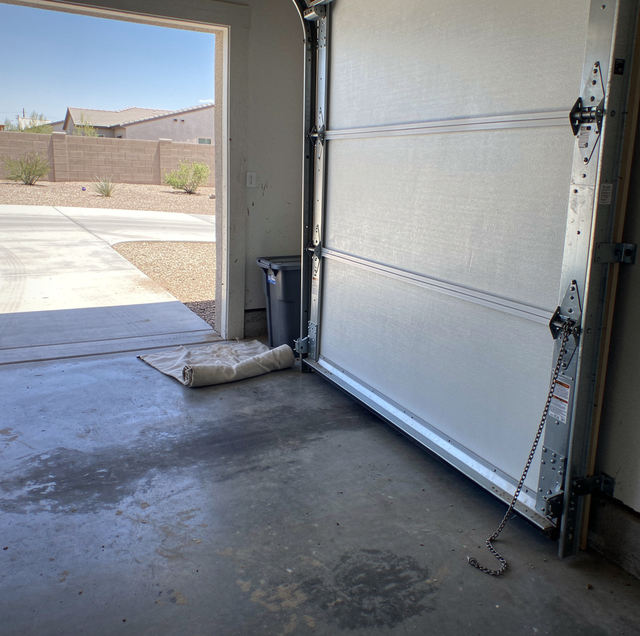
You go to close the garage door, and it stops halfway, tilted so one corner sits noticeably lower than the other. Or it's already down but crooked, like it dropped unevenly rather than settling flat on the floor. A dangling loop of braided wire near one bottom bracket usually confirms it: a lifting cable has snapped.
That crooked angle is the part that throws people off. A broken spring usually leaves a door that won't move at all, evenly stuck in place. A snapped cable does something different. It leaves the door lopsided, hanging correctly on one side and unsupported on the other, because the system on the intact side is still doing its job, while the failed side has nothing to hold it up.
Why One Broken Cable Skews the Whole Door
A sectional garage door hangs from two lifting cables, one at each bottom corner, running up to a drum mounted on the torsion shaft above the opening (or, on an older extension-spring setup, up over a pulley at the top of each track). Each cable carries its own half of the door's weight, wound onto its drum in a specific pattern that keeps the door level as it travels.
When one cable snaps, that corner of the door has no support left. But the shaft and springs don't know that. The torsion spring is still wound with the same tension, still turning the shaft, still trying to pull the surviving cable's drum the way it always has. So the intact side keeps holding its corner up while the failed side drops, and the door ends up racked at an angle instead of falling flat. On a door that was already partway open when the cable let go, that imbalance is what causes the sudden lean or the stop mid-travel.
The steeper the angle, the more the door's own weight presses sideways against the rollers and track on the side that's still supported. A door isn't designed to hang that way for long. The longer it sits crooked, the more chance the rollers on the supported side start binding in the track, or the door corner grinds against the jamb.
Why Forcing It Open Or Closed Is A Bad Idea
The instinct is to muscle the door the rest of the way, either by hand or by hitting the opener button again. Both carry real risk with a cable already broken.
Pushing a crooked door manually puts uneven pressure through the panels and the remaining rollers, which can pop a roller out of the track or bend the track itself. The door is no longer traveling in the straight vertical line the track was built for; it's dragging at an angle, and metal track doesn't flex to accommodate that gracefully.
Running the opener is worse. The opener's drive is built to move a door that's properly counterbalanced by two cables and matched spring tension. With one cable gone, the opener is pulling dead weight on an unbalanced door, and the added strain can snap the second cable, tear the trolley off the opener's drive rail, or force the shaft to twist and bend under one-sided load. If that second cable fails while the door is being forced through a cycle, the door will have no support left and can drop suddenly.
There's also a simpler hazard: the loose end of a snapped cable is a taut length of braided steel wire under whatever residual tension is left in the system, and it can whip or catch a hand that reaches in to try to free it. The safest move once a cable has let go is to leave the door where it is and stop trying to operate it until a technician has released the spring tension properly.
What A Technician Checks Beyond The Broken Cable
A cable doesn't usually snap in isolation. Diagnosing this properly means checking everything the failed cable could have damaged along its route, not just replacing the wire itself.
The drum on the shaft gets inspected first. As a cable frays and finally breaks, loose strands can jump the drum's groove and wind unevenly, or the sudden release of tension can throw the winding off entirely, requiring the drum to be reseated and rewound correctly rather than just re-strung.
The track on the side that dropped gets checked for bending or gouging, since a door corner dragging or scraping against the rail edge as it sagged can leave a track section that's no longer straight enough to guide the rollers cleanly. A track that's even slightly out of true will keep the door from binding or running rough, even after the cable itself is fixed.
The opposite side's cable and spring get inspected too. A shaft under one-sided load, even briefly, transfers extra torque to the still-connected hardware on the far end, and that side can end up with a stretched cable, a strained drum, or a spring showing new wear it didn't have the day before the failure.
Rollers and hinges near the affected corner are checked for damage from the door dropping unevenly, and the bottom bracket the broken cable was anchored to gets examined for bending, since that bracket takes the sudden shock load the instant the cable lets go.
Isolating What Actually Needs Replacing
Once those checks are done, the repair splits into two possible paths. In the more contained case, the cable failed cleanly at a frayed section, the drum and track came through undamaged, and the fix is a cable replacement plus rebalancing the door on the shaft. In the more involved case, the sudden shock load bent the track, damaged a roller, or left the opposite side's hardware showing wear that puts it close to its failure point, and the repair scope expands to include those parts as well.
A technician confirms which situation applies by testing the door's balance and travel after the immediate repair, not just by eyeballing the parts. A door that runs smoothly through a full open-close cycle with even, level travel on both sides has been correctly isolated to the cable. A door that still binds, drags, or tracks unevenly after a cable swap means something else in the run got damaged and still needs attention.
Why Both Cables Usually Get Replaced Together
Even when only one cable snapped and the other looks intact, most technicians replace both at the same visit rather than just the failed one. The reasoning is the same as for a paired spring set: both cables were installed on the same day, cut to the same length, and have carried the door through the same number of open-close cycles since then. Braided steel cable wears from repeated flexing around the drum and bottom bracket, and that flex fatigue builds at roughly the same pace on both sides of a door that opens and closes as one unit.
A cable that hasn't snapped yet can still show fraying, a few broken strands visible near the bottom bracket, or rust working into the wire, all signs that it's approaching the same failure point the other one just reached. Replacing only the cable that already broke leaves a second cable in service that's statistically close to the end of its own life, on a door that's now being handled and rebalanced anyway.
There's also a practical reason tied to how the repair is done. Rebalancing the door correctly means releasing spring tension, working at both drums, and re-tensioning the system evenly, since a mismatch between an old, slightly stretched cable and a brand-new one throws off how evenly the door travels on each side. Installing a new matched pair at the same time keeps that balance intact and avoids a second visit for a cable that was already close to failing.
What The Repair Itself Involves
The process starts by safely releasing the spring tension, since a cable can't be removed or reinstalled while the shaft is still under load. From there, the old cable (or cables) come off the drum and bottom bracket, the drum position and winding are checked against the door's measurements, and a new cable is cut, seated, and wound to match the door's travel exactly on both sides.
Before the tension goes back on, the technician checks the track alignment and roller condition one more time, since those are the parts most likely to have taken secondary damage from the crooked hang. Tension is then gradually and evenly restored on both sides, and the door is run through several full cycles to confirm it travels level, stops, and reverses correctly on the opener's safety sensors, and doesn't drift to one side partway through.
A door that comes out of that process moving evenly, quietly, and level at every point in its travel has been repaired all the way through, not just patched where the cable broke.
Frequently Asked Questions
No. Leave it exactly where it stopped and avoid the opener and manual force alike. A snapped cable means the door is no longer evenly supported, and operating it in that state risks damaging the track, the opener, or the second cable.
The corner that's lower or unsupported is the side with the broken cable. A loose loop of frayed wire hanging near that bottom bracket, or a bracket with no cable attached at all, confirms it.
Not always, but a technician checks the spring and shaft on both sides regardless, since a one-sided load can strain hardware that wasn't directly involved in the original failure.
Because the intact cable and spring on the other side are still under tension and still holding their corner up. Only the side with the broken cable has lost support, which creates the lean rather than an even drop.
No. Spring tension on the shaft stores enough force to cause a serious injury if it's released incorrectly, and that risk is higher, not lower, when a cable has already failed, and the load on the remaining hardware is uneven.
A simple cable replacement on an undamaged track and drum is typically completed during a single service visit. If the inspection finds a bent track or a damaged roller from the sudden drop, the repair will take longer because those parts must be addressed before the door is rebalanced.
Schedule a cable repair inspection — get a full diagnosis of the cable, drum, and track before the door is returned to service. Phoenician Garage Door & Repair serves Phoenix and the Valley. ROC #316471. Call (602) 610-0112.
