
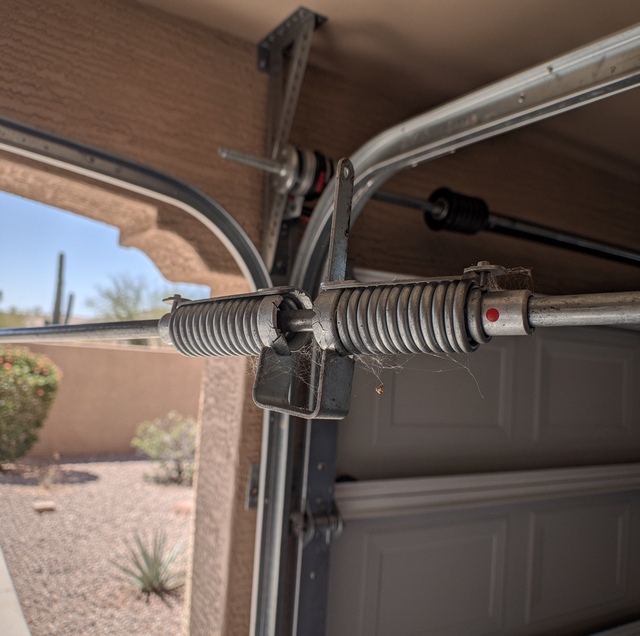
The bang usually happens without warning: a loud crack from above the closed door, then a garage door that won't budge or that suddenly feels like it weighs three times what it did the day before. One torsion spring has let go. The second one, sitting right next to it on the same shaft, still looks wound tight and intact. It's a fair question whether the surviving spring needs to come out too, or whether swapping only the broken one is the smarter move.
How A Paired Torsion System Actually Works
A standard two-spring torsion setup isn't two independent parts that happen to share a shaft. The springs are sized as a matched set: same wire diameter, same coil length, same wind direction pairing (one left-wound, one right-wound), and installed on the same day to counterbalance the exact weight of that specific door. Each spring is stamped or paint-marked near the winding cone with an identifying color that tells a technician its wire gauge and length, and that marking is how a tech confirms a replacement spring is actually equivalent to what's already on the shaft rather than just close enough.
Because the pair was engineered together, they also share a cycle rating. A standard-duty torsion spring is commonly rated around 10,000 open-close cycles before metal fatigue is expected to end its useful life, with higher-cycle springs rated at 20,000, 30,000, or more for doors that see heavier daily use. That rating applies to both springs, since they were built to the same specification and installed at the same time.
Why The Surviving Spring Is Usually Close To Failing Too
Here's the part that surprises many homeowners: the spring that didn't break isn't a new part. It has been through the exact same number of open-and-close cycles as the one that just snapped, wound and unwound under the same tension, exposed to the same heat swings and cycle load since installation day. Torsion steel fatigues gradually through microscopic cracking inside the coil, and that fatigue accumulates in lockstep for both springs in a pair because they've lived an identical life.
Sustained high heat accelerates this further. Repeated cycling through hot afternoons stresses the coil more than the same number of cycles in mild conditions, and heavy dust and grit working into the coil and cone hardware add wear that doesn't discriminate between the spring that already broke and the one still holding on. If one spring reached the end of its fatigue life this month, the other was manufactured to the same tolerance, wound to the same tension, and cycled the same number of times, so it is statistically near the same point on the same curve. It might last another few weeks. It might let go the next time someone hits the remote.
The Safety Problem With An Unbalanced Door
Replacing only the broken spring risks a second repair call later. It changes what happens on the door in the meantime, and immediately after the first repair if the surviving spring is left in place with unknown remaining life.
A door with one worn, high-cycle spring and one brand-new spring is no longer evenly counterbalanced even though it technically has two springs again. The new spring pulls its cable with the tension of a freshly wound coil; the older spring, already partway through fatigue, pulls with something less than that. That mismatch shows up as a door that lists to one side as it travels, tracks unevenly in the rollers, and puts uneven load on the cables and drums on each end of the shaft. Over time, uneven pull is exactly the kind of stress that causes a cable to jump its drum or fray at the bottom bracket.
There's also the failure mode itself to consider. When a torsion spring breaks, it typically does so with the door in the closed position, and the sudden loss of that spring's counterbalance share is why the door feels instantly and dramatically heavier. If the second spring goes while the door happens to be open, or partway through a cycle, there's no counterbalance left to control the descent at all, and an opener not built to catch that kind of dead weight can be damaged trying to fight it. A technician who wound a torsion spring under load compares it to holding a loaded crossbow with the string half-drawn; the tension doesn't announce itself until it's released, and a spring at the tail end of its cycle life gives no outward sign before it lets go.
The Cost Logic: One Visit vs Two
Set the safety question aside for a moment and look at the visit itself. Replacing a torsion spring is not a parts swap a technician can do in isolation; it requires unloading tension from the shaft, removing the broken spring, and, in most cases, removing the second spring anyway to inspect the shaft, bearing plates, and cones before anything goes back on. The bulk of what a homeowner pays for on a spring call is the trip, the diagnostic time, and the labor of safely working with a wound torsion system, not the incremental cost of a second coil of wire. Once a technician has unloaded the shaft, pulled the winding cones, and confirmed the door's weight and drum sizing to install one correctly matched spring, installing the second at the same time adds comparatively little to that visit.
Compare that to the alternative: replace only the broken spring today, and if the older one fails in a few weeks or months, that means a second diagnostic trip, a second round of shaft teardown, and paying for that labor and travel a second time to do a job that could have been finished in one visit. It also means living with an unevenly matched pair in the interim, with the tracking and cable-wear problems described above. When weighed against each other, replacing both springs during the same service call is often the option that costs less over the life of the repair, not more, even though it looks like the smaller job in the moment.
When Replacing Only The Broken Spring Can Make Sense
This isn't an absolute rule, and there are cases where swapping just the broken spring is the reasonable call. A spring that failed early, well short of its rated cycle count, because of a manufacturing defect or an installation error is a different situation than one that broke from ordinary fatigue; if the surviving spring was installed at the same time and is demonstrably nowhere near its expected wear, a technician may recommend replacing only the failed one and monitoring the other. Doors on light usage, where the pair has barely accumulated cycles relative to their rating, sometimes fall into this category too.
The distinction a good technician makes isn't "always replace both" as a blanket policy; it's checking the actual wear evidence on the spring that didn't break; looking at coil spacing, surface rust, cone wear, and comparing the install date and estimated cycle count against the rating, then explaining what that inspection found before recommending single or paired replacement. Skipping that inspection and just guessing either way is the real mistake, not choosing one option over the other in principle.
What A Technician Checks Before Making The Call
A proper inspection of the surviving spring looks at several things side by side: the gap between coils when the door is in the resting position (tight, even spacing suggests a spring still holding its wound tension; visible unwinding or gaps suggest fatigue), surface condition (fine rust pitting on the wire accelerates metal fatigue and is a warning sign on its own), and how the spring compares to its paint-marked size code against what the door's weight actually requires. A tech will also usually ask for or check maintenance records for the installation date, since a five-year-old high-cycle spring reads very differently than one installed eighteen months ago, even if both look intact at a glance.
That inspection is also the moment to confirm the surviving spring is even correctly matched to a new replacement. If the original pair used a wire gauge or coil length that's been superseded, or if the door's weight has changed since the original install (a new insulated door or added hardware, for instance), matching a single new spring to an old one that was sized for different conditions defeats the purpose of a paired system altogether.
Whatever the inspection shows, spring work itself stays a job for a trained technician. A torsion spring under tension stores enough energy to cause serious injury if it's mishandled, and that's true whether one spring is being replaced or two.
Frequently Asked Questions
Look at the horizontal shaft mounted above the door, resting on brackets attached to the header wall. A single-spring setup has one long spring centered on the shaft; a two-spring setup has a spring on each side of a center bearing bracket, each one feeding its own cable drum at the end of the shaft.
Yes. An uneven pull between an old spring and a new one puts extra strain on the roller closest to the weaker side, can pull a cable slightly off its drum groove, and forces the opener's drive gear to work harder to correct the door's path on every cycle, which shortens the opener's life over time.
A rough estimate comes from multiplying the door's average daily cycles by the days since install and comparing that total to the spring's stamped cycle rating. It's an estimate, not a guarantee, since heat exposure and coil condition affect the real number, which is why a visual inspection of coil spacing and rust still matters more than math alone.
Not always, but it's common enough that a technician checks them at the same visit. The sudden drop when a spring lets go can put a shock load on the cables and bottom brackets, and a cable that was already fraying can snap under that extra stress even if the spring failure is what triggered the check.
Not automatically. If only one spring in the pair was replaced previously because of an early failure, the two springs on the shaft may already have different install dates and different remaining life, which is exactly the kind of case where a wear inspection on the older spring, rather than a blanket rule, should drive the decision.
Standard-duty torsion springs are commonly rated at around 10,000 cycles, with high-cycle versions rated at 20,000, 30,000, or higher for doors that are used many times a day. A household running the door two or three times daily might stretch a standard spring past a decade of service, while a door used as a main entrance several times an hour can reach that same cycle count in a fraction of the time.
Schedule a spring inspection — get a straight answer on whether one spring or a matched pair is the right fix for your door. Phoenician Garage Door & Repair serves Phoenix and the Valley. ROC #316471. Call (602) 610-0112.
