
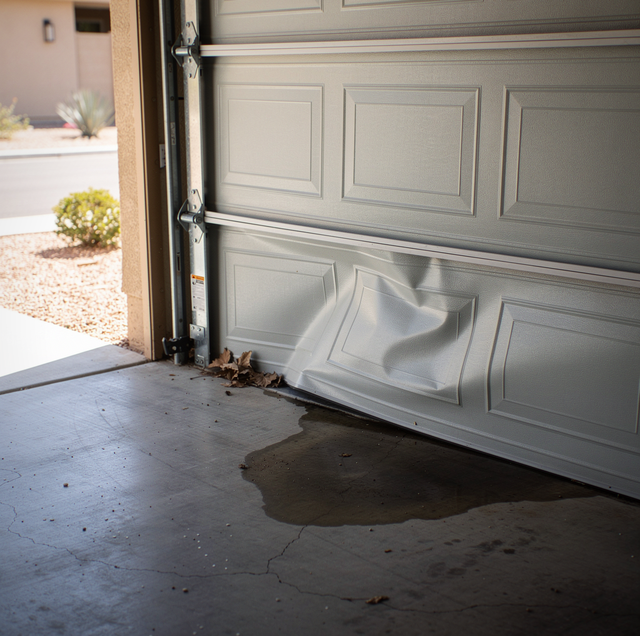
A car backing out too fast, a stray basketball, a ladder that tipped the wrong way: dents in a garage door panel almost always trace back to a single moment of contact, and the damage they leave behind ranges from a shallow cosmetic dish to a crease that changes how the whole door moves. The dent itself is obvious. What's less obvious is whether the fix is a single new panel swapped into an otherwise sound door, or a decision that the whole door needs to come down. That decision depends less on how bad the dent looks and more on what it did beneath the surface and whether a matching panel for that specific door still exists.
What A Dent Actually Damages
A garage door panel is a formed sheet of steel or aluminum, sometimes with a foam core bonded to the back, held flat by the ribs stamped into the metal and by its connections to the hinges, tracks, and neighboring panels. A dent is the visible result of that metal losing its shape under an impact, but the impact doesn't always stop at the surface.
A shallow, rounded dent that sits between the ribs and doesn't touch a hinge point or the panel's edge is usually cosmetic. The panel still holds its overall shape, the hinges on either side still line up the way they did before, and the door still travels through its full range of motion without binding. That kind of damage is unattractive but mechanically quiet.
A dent that lands near a hinge, a panel seam, or where a roller stem bolts into the panel is a different situation. Metal pushed out of shape at those points can pull the hinge slightly out of alignment, change the angle at which the roller stem meets the track, or distort the seal where one panel meets the next. That's the kind of damage that shows up later as a door that runs rough, a roller that pops out of the track, or a gap where weather and dust start working their way in.
How To Tell A Cosmetic Dent From A Structural One
A few checks can separate a dent that's purely cosmetic from one that affects how the door runs, and most of them can be done without any tools.
Run a hand flat across the panel surface, feeling for a crease or fold rather than a smooth dish shape. A crease means the metal has been bent past its ability to spring back, which is a stronger sign of structural change than a shallow dent that simply pushed the panel surface inward.
Open and close the door slowly while watching the section with the dent. A door that hesitates, jumps, or makes a new grinding or popping sound at the point where that panel passes the rollers is telling you the dent has shifted something in the roller-to-track relationship, not just the paint.
Check the seam where the damaged panel meets its neighbor above or below. A panel-to-panel seal that used to sit flush and now shows a visible gap or overlap at the dent's location means the impact pushed that edge out of plane, which affects both weather sealing and how evenly the sections stack when the door is closed.
Watch the door's balance. Disconnect the opener and manually lift the door partway; a door that's still properly balanced should stay roughly in place when released midway. A door that suddenly drops or shoots upward after a panel impact suggests the dent affected more than cosmetics, since a warped panel can bind against the track and throw off the counterbalance the springs are set up to manage.
Any of those signs point to a repair that needs to address more than just the dent's appearance, and that's where the repair-versus-replace comparison actually starts.
Single-Panel Repair vs Full Door Replacement at a Glance
| Factor | Single-Panel Repair or Replacement | Full Door Replacement |
|---|---|---|
| Relative cost | Lower overall cost in most cases; limited to one section, its hardware, and labor for that section alone | Higher overall cost, covering every panel, all hardware, and full installation |
| Matching panel availability | Depends entirely on whether the door's age, brand, and model still has that exact panel in production or in stock | Not a concern; a new door is built or selected as a complete matched set |
| Visual uniformity after the fix | A newer panel can look slightly different from sun-faded neighbors in texture, sheen, or color match | Every panel matches perfectly since the whole door is new |
| Structural impact on balance and operation | Corrects the issue if the panel and its hardware are properly realigned; doesn't touch other panels' condition | Resolves any panel-specific issue completely, along with age-related wear on the rest of the door |
| Effect of door age or discontinued models | An older or discontinued model may have no available replacement panel, which forces the decision toward full replacement | Sidesteps the matching problem entirely since age and discontinued styling no longer matter |
The Availability Problem Nobody Sees Coming
The comparison above looks simple until a technician actually tries to source the part, and this is where the decision often gets made for a homeowner rather than by the homeowner. Garage door manufacturers change panel profiles, rib patterns, and window inserts over time, and a door that's five, ten, or fifteen years old may have gone through one or more design revisions since it was installed. A panel ordered today under the same model name isn't guaranteed to match the rib spacing, thickness, or embossing pattern of a panel made a decade earlier.
Doors that have been fully discontinued present the sharper version of this problem. If the manufacturer no longer produces that model or panel style, there's no order to place, matching or otherwise. A technician can sometimes source a used panel from a salvage supplier, but that route depends on finding the right style in serviceable condition. When a panel simply can't be sourced, single-panel repair is no longer an option, regardless of how minor the dent is, and full replacement becomes the only path forward.
Color adds a second layer to the same problem. Even when the panel profile matches exactly, factory paint runs vary batch to batch, and years of sun exposure fade an existing door unevenly compared to a panel that's never been outside a full season. A brand-new panel dropped into an older door will usually be a visibly different shade for a while, sometimes permanently.
Weighing Visual Uniformity Against The Rest Of The Comparison
For many homeowners, the color-and-texture mismatch is a trade-off worth accepting. A panel that's a slightly different shade in a spot most people don't examine closely still costs far less to correct than replacing a door that's otherwise working fine, and the mismatch often fades further as the new panel weathers alongside the rest of the door.
Where that tradeoff stops making sense is on a door in a highly visible spot, like one facing the street on a home where curb appeal carries real weight, or where the damaged panel sits at eye level rather than near the bottom. In those cases, some homeowners replace two or three panels instead of one, spreading the mismatch across enough of the door's face that it reads as intentional rather than obviously patched, or decide the full-door route is worth it purely for the finished look.
When A Dent Signals The Door's Age Is The Real Issue
A single dent on an otherwise healthy door is usually a simple panel-level fix once the matching question is settled. But a dent is sometimes the event that surfaces a bigger picture: a door that's been showing other age-related wear, like tracks that have needed repeated realignment, an opener working harder than it used to, or hardware that's been patched more than once already.
In that situation, the dent becomes a decision point rather than an isolated repair. Spending on a single panel for a door already showing multiple unrelated wear patterns can mean facing a second, third, or fourth repair on the same door within a short stretch. A technician who inspects the entire door, not just the dented section, before quoting the fix reveals whether a panel swap solves the actual problem or only the most visible symptom.
What A Proper Panel Replacement Involves
Swapping a single panel isn't as simple as unbolting one section and bolting in another. The hinges connecting the damaged panel to its neighbors typically move to the new panel, since hinges are set to a door's specific track geometry and swapping the panel without checking hinge condition risks carrying an existing alignment problem into the repair. Roller stems, end brackets, and any struts reinforcing that panel need the same inspection, since a dent severe enough to warrant replacement often bent or stressed that hardware too.
After the new panel goes in, the door needs a full-cycle test, not just a visual check: run it through several open-close cycles while watching for smooth roller travel, a level top edge as the door closes, and a seal that sits flush against its neighbors. Skipping that step is how a technically correct panel swap still leaves a door that binds or runs unevenly, because the fix addressed the panel but not how it settled back into the rest of the assembly.
Making The Call
The decision comes down to three questions: can a matching panel actually be sourced for this door's age and model, is the visual mismatch something you're willing to live with in that spot, and does the rest of the door show enough other wear that a full replacement makes more sense than patching one more issue on an aging system. A cosmetic dent on a door with a sourceable panel and no other wear patterns is usually an easy, contained fix. A structural dent on a door that's already discontinued, showing its age elsewhere, or damaged where a mismatch would stand out is the situation where full replacement earns a real look rather than staying the fallback option nobody wants to pick.
Frequently Asked Questions
Sometimes, for a shallow dent on a section with enough flat area to work with, though garage door steel is thinner than automotive-body steel and doesn't always spring back cleanly the way a car panel does. A crease or a dent near a rib, hinge, or seam is much less likely to respond to this approach and usually calls for panel replacement instead.
No. A shallow, purely cosmetic dent away from hinges and seams typically leaves balance untouched. Balance problems arise when the dent is severe enough to bind against the track, distort a hinge point, or create uneven weight or resistance as the panel travels, which is why the balance check matters more than the dent's visible size.
Once a matching panel is confirmed and on hand, swapping a single panel and its hardware is typically a same-visit repair for a technician, including the cycle testing needed to confirm the door runs evenly afterward. Sourcing a panel that isn't in regular stock is what extends the timeline, not the installation itself.
That's a judgment call specific to the door and the homeowner's tolerance for a partial mismatch. A technician can usually source a close structural match even when decorative details like window inserts or embossing don't line up exactly, and whether that's acceptable often depends on how visible that section of the door is.
In some insulated panel designs, the outer steel skin can be separated from the foam core and hardware, allowing a skin-only replacement in specific cases. It's a narrower repair than a full panel swap and depends on the door's construction, so it's worth asking a technician whether that option applies before assuming a full panel is required.
It can, particularly if the dent sits near a seam or hinge where it was already affecting alignment. Years of continued cycling with a slightly misaligned panel add wear to the rollers, track, and hinges around it, which is why an old, cosmetic-looking dent is worth a second look rather than assuming it's harmless just because the door still opens and closes.
Get a dent evaluated before deciding between a panel fix and a full door — a technician can confirm whether a matching panel is available for your door. Phoenician Garage Door & Repair serves Phoenix and the Valley. ROC #316471. Call (602) 610-0112.
