
One Spring vs. Two Garage Door: Which Setup Lasts?
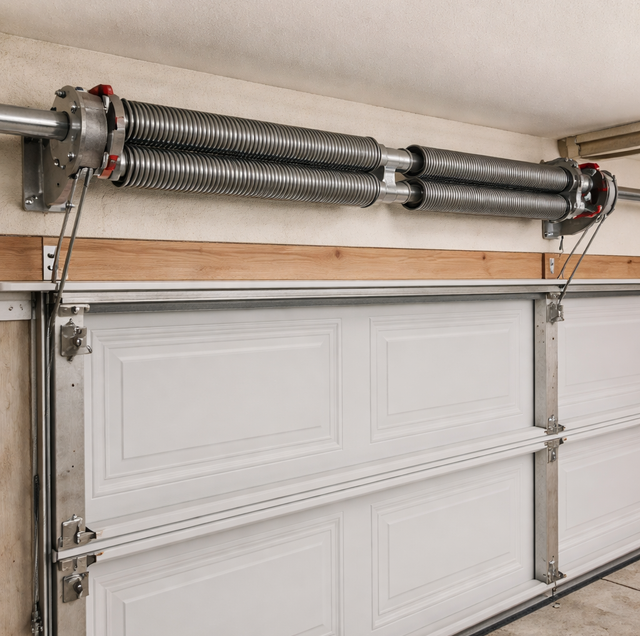
Quick Answer: A two-spring torsion system splits the door's weight across two springs, so each one works less, lasts longer, and fails more gently than a lone spring carrying the whole load. A single spring is fine on lighter, narrower doors, but a heavy or wide door is usually a strong candidate for a two-spring setup. Spring work is high-tension and pro-only in every case.
A sectional garage door is one of the heaviest moving objects in a home, and almost none of that weight lands on the opener. The real lifting is done by the torsion spring mounted on a steel shaft above the opening. Wound tight, it stores energy and releases it as the door rises, so the motor only has to nudge a load that is already close to balanced. When people ask whether a single-spring door should be running two, they are really asking about how that stored energy is divided, and what happens the day a spring finally lets go.
How A Torsion Spring Counterbalances The Door
The torsion spring does not lift the door directly. It winds a tightly coiled steel spring around a shaft, and cables wrapped around drums on each end of that shaft connect down to brackets at the bottom of the door. As the door comes down, the cables wind the drums and load the spring; as the door goes up, the spring unwinds and pays that energy back through the cables to raise the panels.
The goal is balance. A properly sized spring is matched to the door's exact weight so that, at any point in its travel, the door will more or less hold its position when you stop it by hand. That is why a healthy door feels light even though it may weigh well over a hundred pounds. The opener is only there to start the motion and hold the door where the spring leaves it, not to haul the full load. When a spring is weak, undersized, or broken, the opener suddenly has to fight weight it was never built to move, and that is when motors burn out and gears strip.
Why Many Wide Or Heavy Doors Run Two Springs
The single-versus-double question is not about power. Two springs do not lift more than one correctly sized spring; the total counterbalancing force is the same either way. The difference is how that force is produced and shared.
Load-sharing means each spring works less: Split the required force across two springs and each one only has to supply half. A spring that carries half the load is wound to a lower tension and cycles under less stress than a lone spring doing the entire job. Less stress per cycle is the single biggest reason a two-spring door tends to outlast a comparable single-spring one, all else being equal.
Balanced pull across a wide door: On a wide double-car door, a single central spring pulls the cables from one point. Two springs, one feeding each cable drum, distribute the pull more evenly across the width of the door. That even pull helps the door track squarely instead of racking to one side, which is easier on the rollers, the track, and the cables over years of use.
Safer behavior when a spring fails: Every torsion spring eventually breaks, usually with a loud bang as the coil snaps. On a single-spring door, that one spring was holding all of the counterbalance, so when it goes, the door becomes dead weight and can drop hard or refuse to move at all. On a two-spring door, a broken spring leaves the second spring still holding roughly half the load. The door is out of balance and unsafe to operate, but it does not lose its entire counterbalance in an instant. That gentler failure is a genuine safety advantage, though it is never a reason to keep operating the door or to attempt a repair yourself.
When A Single Spring Is Perfectly Fine
Redundancy costs something, and not every door needs it. A single, correctly sized torsion spring is a completely legitimate design for the right door.
Lighter single-car doors, especially non-insulated steel or aluminum panels on a standard opening, put modest weight on the system. A single spring rated for that weight will counterbalance it accurately and cycle for years without complaint. Adding a second spring to a light door buys little extra life and no meaningful safety gain, because the lone spring was never heavily stressed to begin with. Narrower openings also make a centered single spring easy to size and balance.
The distinction that matters is weight, not door count in the abstract. An insulated door, a solid-wood or faux-wood door, or a door with heavy decorative hardware can weigh far more than a plain single-car panel, and those are the doors where a single spring starts working hard enough that two would clearly serve it better.
The Case For Upgrading A Heavy Door To Two Springs
If a heavy or wide door is running on one spring, converting it to a balanced two-spring system is often a worthwhile upgrade rather than a repair. The logic follows directly from load-sharing: two springs, each carrying half the weight, are wound to lower tension, so both cycle under less stress and tend to reach a higher cycle count before fatigue ends them.
There is a rhythm here worth noticing. A relay runner who sprints one leg and hands off the baton finishes fresher than a lone runner covering the whole distance flat out, and a spring that only ever carries half the door behaves the same way, aging slower because it is never fully taxed. Pair that longer life with the gentler failure behavior and the squarer tracking on a wide door, and a heavy single-spring setup becomes a strong candidate for conversion.
An upgrade is a real decision, not automatic. It involves new springs sized for the door, and on some single-spring installations the shaft, drums, or bearing plates may need attention to accept a second spring. The value is highest on doors that see heavy daily use, or that already feel like they are straining the opener, and it is smallest on a light door that is balancing well as it stands.
Cycle Life, Usage, And Why Springs Wear Out
Torsion springs are rated in cycles, where one cycle is a single full open-and-close. A common builder-grade spring is rated around 10,000 cycles, while higher-cycle springs are available at roughly 20,000, 30,000, or more. That number is not a warranty of exact lifespan; it is an engineering estimate of how many times the steel can be wound and unwound before metal fatigue catches up with it.
Usage is what turns that rating into calendar years. A door opened twice a day burns cycles slowly, and a builder-grade spring can last a decade or more. A busy household that runs the door six, eight, or ten times a day, or one where the garage serves as the main entrance, chews through the same rating in a fraction of the time. This is where two-spring load-sharing compounds: each spring not only starts under lower stress, it also accumulates fatigue more slowly per cycle, which is why high-cycle springs and two-spring conversions are often specified together for doors that get heavy traffic.
Wear also shows up before the final break. A spring losing tension leaves the door heavy at the floor, sluggish to lift, or unable to hold a mid-travel position. Those are cues that the counterbalance is fading, and they are worth a professional look before the spring snaps rather than after.
A spring losing tension shows up before it breaks. If the door feels heavy at the floor, lifts sluggishly, or will not hold a mid-travel position when you stop it by hand, the counterbalance is fading, and it is worth a professional look before the spring snaps.
Why Matched And Properly Sized Springs Matter
On a two-spring door, the pair has to be a matched set: same wire size, same inside diameter, same wound length, and correctly handed so one winds left and the other winds right. Mismatched springs pull unevenly, so one carries more than its share, fatigues faster, and drags the door out of balance, which quietly undermines the whole point of running two.
Sizing is equally load-bearing. A spring is chosen for a specific door weight, and an undersized spring leaves the door heavy and overworks the opener, while an oversized one makes the door want to fly up and float at the top. Getting the wire diameter, coil length, and drum size right for the measured door weight is what produces a door that feels weightless by hand. Guesswork here does not just shorten spring life; it stresses cables, rollers, and the opener across the entire system.
Why Spring Work Is Strictly Pro-Only
A wound torsion spring stores an enormous amount of mechanical energy, and it stays loaded whether the door is open or closed. Winding, adjusting, unwinding, or replacing one puts your hands next to that stored force, and a slip or a snapped winding bar can cause serious injury. A second spring still holding half the load leaves the shaft just as dangerous, so spring work is pro-only either way. This is not a task that scales down for a careful homeowner.
The safer failure behavior of a two-spring system does not change any of this. A second spring still holding half the load means the shaft is still under heavy tension, so a two-spring door is exactly as dangerous to service as a single-spring one. Sizing the springs, counting turns, matching a pair, and testing the balance are all judgment calls that belong to a trained technician with the correct bars and hardware. Diagnosing the door and choosing between one spring and two is worth doing; doing the actual spring work yourself is not.
Frequently Asked Questions
Not always without changes. Many single-spring doors use a shorter torsion shaft, a single center bearing, and drums positioned for one central spring. Fitting a matched pair can require a longer shaft, an added end bearing plate, and sometimes different cable drums so each spring feeds its own cable. A technician measures the existing hardware and the door weight before confirming a clean two-spring conversion is possible.
Look at the horizontal steel shaft mounted on the wall just above the closed door. Count the coiled springs threaded onto it: one long spring usually sits centered over the middle of the door, while a two-spring setup shows a spring on each side of a central winding cone or bearing bracket. Never touch either one to check; a wound spring is under tension even when it looks still.
No, they are different systems. Torsion springs sit on the shaft above the door and store energy by twisting. Extension springs run along the horizontal tracks on each side and store energy by stretching. Extension-spring doors are normally two-sided by design and should have safety containment cables run through them, so the single-versus-two question in this article is specifically a torsion-spring one.
No. Opening speed is set mainly by the opener's travel rate and the drum size, not by the number of springs. What a balanced two-spring setup changes is how evenly the door is lifted and how long the springs last, not how quickly the door travels. If a door feels slow, the cause is more often a tiring opener or a fading spring than the spring count.
An annual professional inspection is a sensible baseline for an average-use door, and more often for a door cycled many times a day. Between visits, run a quick balance test: with the door disconnected from the opener by pulling the release, lift it halfway by hand and let go. A balanced door holds; one that slams down or shoots up signals a spring losing calibration and is worth booking before it breaks.
It can. When a spring snaps, the sudden loss of counterbalance can let the door drop and put shock loads on the cables, bottom brackets, and rollers, and forcing the opener to lift the dead weight afterward can strip its gears or burn the motor. The safest move is to stop using the door the moment a spring breaks and to leave it closed until a technician replaces the spring and checks the parts around it.
Book a spring inspection or a two-spring upgrade quote — get a door that lifts easily and fails safely. Phoenician Garage Door & Repair serves Phoenix and the Valley. ROC #316471. Call (602) 610-0112.
