
Nylon vs. Steel Garage Door Rollers: Which Lasts Longer?
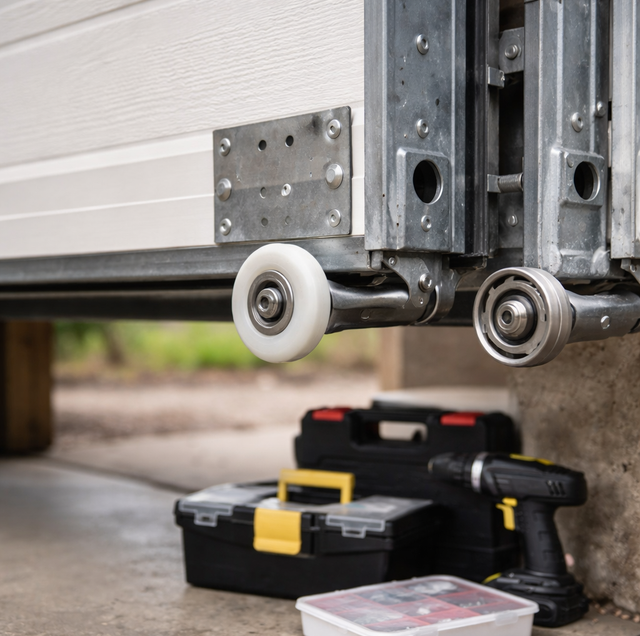
Every time a sectional garage door opens or closes, a set of small wheels does the quiet work of carrying its weight. Those wheels are the rollers, and they are one of the most overlooked parts on the whole system until they start making noise or the door begins to fight you. Choosing between nylon and steel rollers is one of the few upgrade decisions a homeowner actually gets to make, and the two materials behave differently enough that it is worth understanding before you buy.
Quick Answer: Nylon rollers run quieter and need no lubrication on the wheel itself, while steel rollers are tougher against impact but louder and prone to rust and flat spots. For most residential doors, quality nylon rollers with sealed ball bearings last as long or longer while keeping the door quiet.
What Garage Door Rollers Actually Do
A roller has two parts: the wheel that rides inside the track, and the stem (the shaft) that slides into a hinge or bracket on the door. As the door travels up and around the curved section of track, each roller rotates and keeps its section of the door aligned so nothing binds or scrapes the metal.
A standard residential door usually carries ten rollers, two per section on a five-panel door, though panel counts vary. They share the load, so when one starts to drag or seize, the others take on stress they were not sized for, and the whole door begins to feel rough.
The wheel spins on an internal bearing, and this is where most of the real difference between roller types lives. The bearing is a ring of small steel balls that let the wheel turn with very little friction. Cheaper rollers may have as few as seven ball bearings; better ones carry ten, eleven, or thirteen. More bearings spread the load across more contact points, so the wheel turns smoother and the bearing wears slower.
Sealed versus unsealed bearings: Bearings come sealed or unsealed. An unsealed bearing is open to the air, which means dust, grit, and debris can work into the raceway where the balls ride. A sealed bearing has a shield that keeps contaminants out and the factory grease in.
When comparing rollers, judge the bearing first and the wheel material second. Sealed bearings are the single strongest quality marker on any roller, nylon or steel, because a contaminated bearing fails long before the wheel material wears out.
Nylon Rollers: Quiet and Low-Maintenance
Nylon rollers use a hard plastic wheel, almost always paired with a steel ball-bearing core. The nylon rides against the steel track with a softer, quieter contact than metal-on-metal, which is why doors fitted with nylon rollers are noticeably calmer, especially in an attached garage with a bedroom overhead.
The wheel itself needs no lubrication. Nylon is self-lubricating in the sense that it glides against steel without grease, so you never oil the wheel, and there is no lubricant on the wheel face to attract the dust that would otherwise build into grime. The sealed bearing inside holds its own grease and is not meant to be oiled by hand.
Nylon does have limits. A hard impact, such as backing a vehicle into the door or a heavy strike, can chip or crack the wheel where steel would simply dent. Sunlight and years of use can also make the plastic brittle over time. Quality matters here: a thin, low-bearing-count nylon roller is a poor buy, while a thick-walled nylon wheel on a sealed thirteen-ball bearing is a long-lasting part that earns its keep.
Steel Rollers: Tough but Noisy
Steel rollers use a metal wheel, and metal shrugs off impacts that would chip nylon. On a heavy door, a commercial door, or a door that sees rough use, that toughness is real. Builders also default to plain steel rollers as the low-grade standard, which is why so many doors arrive from the factory with the noisiest rollers installed.
The tradeoffs are loud and physical. Steel-on-steel contact rings through the track and the door frame, so a steel-roller door is the one you hear from across the house. The wheel needs periodic lubrication to run smoothly and to slow wear, and that oil film catches dust and turns into an abrasive paste over time.
Two failure modes are specific to steel. Rust can form on the wheel or in the bearing when moisture reaches bare metal, and a rusted bearing grinds instead of rolls. A flat spot can develop when a door sits closed on the same rollers for long stretches, leaving each wheel resting on one point until it wears a shallow flat; the door then thumps rhythmically as those flats come around. Nylon resists both problems because it does not corrode and springs back from a resting load.
Durability, Noise, and the Real Tradeoff
Roller life is measured in cycles, one cycle being a single open-and-close. A home that runs its door six to eight times a day builds cycles faster than you would guess, and rollers are consumables that wear out on that clock. A basic builder-grade roller, nylon or steel, is often rated for the low tens of thousands of cycles, while premium rollers with high bearing counts and sealed bearings are rated several times higher.
Here is the honest comparison. Bare steel rollers survive impact better and come standard on many new doors, but they are louder, they demand lubrication, and they can rust or flat-spot. Quality nylon rollers with sealed, high-count bearings run quiet, ask for almost no maintenance, resist corrosion, and in normal residential use match or outlast cheap steel because the bearing, not the wheel, is what usually gives out first, and a sealed bearing is protected on both roller types.
A helpful way to frame it: the wheel material decides how the door sounds and how it handles an impact, but the bearing decides how long the roller lives. A premium nylon wheel on a junk bearing will fail early, and a steel wheel on a sealed thirteen-ball bearing can run a long time. Judge rollers by the bearing first, the wheel material second.
For most homeowners on a standard sectional door, quality nylon rollers with sealed ball bearings are the better all-around choice: quieter, cleaner, and long-lived. Steel earns its place on heavy or commercial doors, or where impact resistance outranks noise.
Signs Your Rollers Are Worn
Rollers rarely fail all at once. They announce themselves, and catching the signs early keeps a cheap part from turning into an alignment problem.
Grinding or squealing: A dry, grinding, or squealing sound as the door moves usually points to a failing bearing or a dry steel wheel. On nylon rollers, grinding often means the sealed bearing has finally worn through, since the wheel itself runs silent when healthy.
Wobble or a leaning wheel: Look at the rollers as the door runs. A wheel that wobbles on its stem, tilts, or no longer sits square in the track has a worn bearing or a bent stem. A wobbling roller drags on the track edge and speeds up wear on itself and its neighbors.
Jumping or binding in the track: If the door hops, catches, or looks like it wants to climb out of the track, a seized or badly worn roller is a prime suspect. A roller that no longer spins slides instead of rolls, and a sliding wheel can walk the door out of alignment or off the track entirely.
Why Roller Work Near the Bottom Bracket Is Dangerous
The roller in each bottom bracket sits where the lifting cable attaches, under the full tension of the door's counterbalance system. Loosening or removing a bottom bracket, or the roller in it, can suddenly release that stored energy, and a cable under load can whip with enough force to cause serious injury. Leave the bottom bracket, cables, and springs to a technician. The same warning covers the springs that create the tension in the first place; high-tension torsion and extension springs are pro-only parts.
You can safely watch your rollers run, listen for the signs above, and keep the track clear of debris. Actual roller replacement, and anything involving the bottom bracket, cables, or springs, belongs to a trained technician who has the tools to secure the tension first. It is a modest job for a pro and a genuine hazard for a homeowner.
Frequently Asked Questions
It works mechanically, but it is not ideal. Rollers of different materials and bearing grades roll at slightly different resistances, so a mixed set can make the door track unevenly and wear the odd-one-out faster. When you replace rollers, do the full set of ten at once so they age together, and the door runs balanced.
Yes, but the plastic gets slightly more brittle as temperatures drop toward and below freezing, so a hard impact in deep cold is more likely to chip a nylon wheel than the same hit in mild weather. Warm daytime use is easy on them. Because nylon behaves differently at both ends of the thermometer, a quality thick-walled wheel is worth the difference if your garage sees wide swings.
There is no fixed calendar; rollers wear on cycles, not years. A rough rule technicians use is to have them inspected around every 10,000 cycles and expect replacement somewhere in that range for builder-grade parts, later for premium sealed rollers. A household opening the door eight times a day reaches 10,000 cycles in roughly three and a half years.
Some of the cheapest rollers are solid nylon wheels with no ball bearing at all; the wheel simply spins on the stem. They are the quietest option brand new but wear out fast and start to wobble, because there is no bearing to carry the load precisely. They suit a lightly used door but are a poor pick for a door in daily service.
A light lubricant on the track hinges and steel roller stems can quiet a door briefly, but it does not fix a failed bearing. Avoid spraying heavy grease inside the track itself, since it collects grit and makes rollers slide rather than roll. If a roller still grinds or wobbles after cleaning and light lubrication, the bearing is gone, and the roller needs replacing.
Rollers are the most common cause of a noisy door, but not the only one. Loose hinges, an under-lubricated chain or belt on the opener, or worn bearings in the spring assembly can all add noise. A quick way to isolate rollers: if the loudest sound comes from the door tracking up and around the curve rather than from the opener unit, the rollers are the likely culprit.
Book a roller inspection before a worn wheel jumps the track — quieter operation and a door that runs true. Phoenician Garage Door & Repair serves Phoenix and the Valley. ROC #316471. Call (602) 610-0112.
