
How Garage Door Safety Sensors Work (and Why They Reverse)
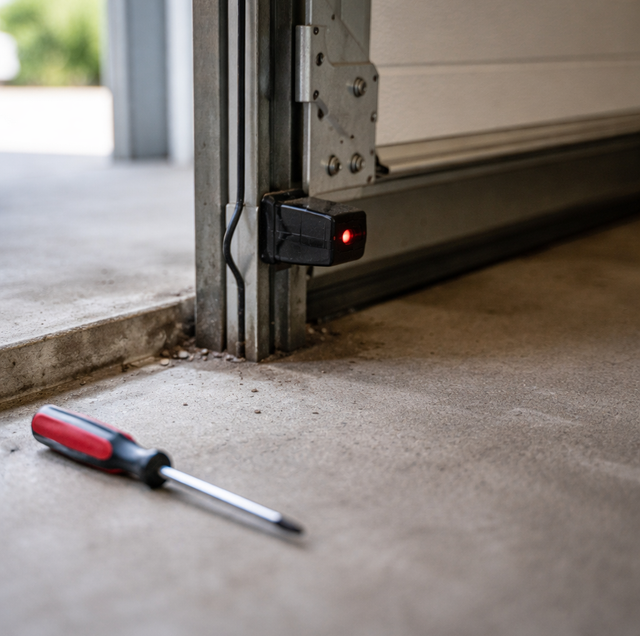
Quick Answer: Garage door safety sensors, also called photo-eyes, are two small units mounted near the floor on each side of the opening. One sends an invisible infrared beam across the doorway; the other receives it. If anything breaks that beam while the door is closing, the opener stops the door and reverses it back up. It is a federally required safety feature, and it is the reason a closing door will not crush a person, a pet, or the back of a car.
Most people meet their safety sensors the day the door refuses to close. It starts down, then rolls right back up, sometimes with the opener light flashing. Before assuming the opener has failed, it helps to understand the two little eyes bolted near the floor, because nine times out of ten they are the reason the door is behaving this way.
What Photo-Eye Safety Sensors Actually Are
Look at the bottom of your garage door track on each side, roughly six inches off the floor. You will find two small plastic housings facing each other across the opening, each with a short pigtail of wire running back toward the opener or the wall. Those are the photo-eyes.
One eye is the sender. It emits a focused beam of infrared light, which sits just outside the range human eyes can see, straight across the doorway to its partner. The other eye is the receiver. Its only job is to keep seeing that beam. As long as the receiver detects the beam, it tells the opener the path is clear. Break the line of light, and the receiver reports the interruption instantly.
Both eyes are wired to the opener's logic board. This matters because the sensors do not act on their own. They report to the opener, and the opener decides what to do. When the beam is intact and you press the button, the door closes normally. When the beam is broken during a close, the opener cuts the down command and drives the door back to open fully.
The reverse in plain terms: An alarm on a store's front door only chimes when you walk through it. A photo-eye works the opposite way. It is the unbroken beam that signals "safe," and any break in it that signals "stop." So a bird flying through the gap, a trash can rolled into the path, or a foot stepped across the threshold all produce the same result: the closing door halts and reverses. The sensors do not decide whether the object is a leaf or a toddler. They only know the beam was interrupted, and interruption always wins.
Why Every Opener Has Them
Photo-eyes are not an upgrade or an accessory. In the United States, garage door openers manufactured since the early 1990s have been required by federal safety rules to include an external entrapment protection system, and the photo-eye beam is how nearly every modern opener meets that requirement. The rule followed a period of serious entrapment injuries, including children caught under closing doors.
A residential garage door is one of the heaviest moving objects in a home. The panel and hardware together can weigh well over a hundred pounds, and the opener drives it with enough force to seat it firmly against the floor. Without a way to detect something in the path, that force lands on whatever is there. The photo-eye system gives the door a second, independent way to know it should stop, separate from the door's own travel limits.
There is a companion safety system worth naming here, because the two often get confused. The auto-reverse force setting is a mechanical sensitivity built into the opener that reverses the door if it contacts a solid object on the way down, even in the dark with no beam. The photo-eyes catch objects before contact. The force reversal catches them at contact. A well-maintained door has both working and testing, and testing is covered further down.
The Problems That Trip Them, and the Fixes
When a door refuses to close because of the sensors, the cause is almost always one of a short list. Most are things a homeowner can spot and correct.
Misalignment: The eyes have to point at each other. If a bracket gets bumped by a bike handlebar, a stored box, or a lawn mower, one eye ends up aimed slightly off, and the receiver can no longer find the beam.
The sensors report their own status through small LED lights on each housing. On most brands, a steady glow on both eyes means the beam is connecting, while one steady light and one that is off or blinking is the classic signature of misalignment. Gently nudge the blinking eye until its light goes solid and stays solid.
A dirty or fogged lens: The lens is a small clear window, and it collects dust, spider silk, cobwebs, and film over time. Enough buildup scatters the beam and the receiver reads it as broken. A soft dry cloth, or one barely dampened with water, wiped across both lenses often restores a clean connection in seconds. Skip solvents and paper towels, which can scratch the plastic.
Bright light washing out the receiver: Low-angle sunlight or a bright work lamp aimed straight into the receiver can overwhelm it, drowning the sender's beam the way a flashlight disappears against the sun. This tends to happen only at certain times of day and clears on its own as the light angle shifts, which is a useful clue. A small sun shield or slightly repositioning the eye usually solves a recurring case, and it can happen in any season depending on how the light falls through the opening.
A loose, pinched, or damaged wire: Each eye runs on a thin low-voltage wire back to the opener. A staple driven too tight, a wire nicked by a string trimmer, rodent damage, or a connection that has vibrated loose will interrupt the signal even when the eyes are perfectly clean and aligned. If the lenses are spotless and the alignment looks right but a light still will not come on, suspect the wiring. This is the point where the fix usually crosses from homeowner territory into pro territory.
An actual obstruction: Sometimes the system is working exactly as designed. A broom handle, a garden hose, a pile of leaves blown under the door, or a pet bed left in the gap will break the beam. Walk the threshold and clear anything sitting in the low path across the opening before assuming a fault.
How to Tell It Is the Sensors and Not Something Else
The behavior pattern is the tell. A sensor problem shows up as a door that starts down and reverses back to full open, usually the moment travel begins or within the first foot, and it repeats every time. Remote and wall button both do it. The door opens fine; it only refuses to close.
Many openers add a diagnostic signal. When the safety circuit blocks the down command, the opener's light bulb often flashes a set number of times, or a status LED on the motor housing blinks a code. The number of flashes points to the cause, and the opener's manual translates it. A steady flashing tied to sensor faults is a strong sign the eyes, not the motor or the springs, are the issue.
Contrast that with other failures. A door that closes fully but then pops back up a few inches is more likely a travel-limit or force setting, not the photo-eyes. A door that will not move at all, hums, or moves points toward the motor, the trolley, or a broken spring unevenly. And a door that closes normally by holding the wall button but not otherwise is a specific clue on its own: many openers let a held button bypass the beam, so if constant pressure closes the door, the sensors are almost certainly the culprit.
What You Can Safely Do Yourself Versus When to Call a Pro
The homeowner-safe checks are the ones that keep you clear of anything under tension. Wipe both lenses clean. Look at the LED lights and note which is misbehaving. Clear the path across the threshold. Check that neither bracket got knocked, and realign the eyes by hand until both lights glow steady and hold. Confirm nothing bright is shining directly into the receiver. These four or five steps resolve the large majority of sensor complaints and involve nothing more forceful than a cloth and a gentle push.
Call a technician when the trail leads to the wiring or the electronics. Splicing or replacing low-voltage sensor wire, diagnosing a failed eye that stays dark after cleaning and alignment, and tracing a fault back to the opener's control board are jobs where guessing can leave the safety system half-working. And two areas are pro-only on any door: the springs and the opener's internal drive are under high tension and store enough energy to injure someone badly, so those are never a DIY realignment task.
One rule sits above all the troubleshooting. Never disable, unplug, tape over, or permanently bypass the photo-eyes to force a stubborn door to close. The beam is the barrier between a heavy closing door and whatever is beneath it. Defeating it to get through a busy morning removes the one system designed to stop the door from crushing a child, a pet, or a car bumper.
Never disable, unplug, tape over, or permanently bypass the photo-eyes to force a stubborn door to close. The beam is the barrier between a heavy closing door and whatever is beneath it, and defeating it removes the one system designed to stop the door from crushing a child, a pet, or a car bumper. If the door will not close and you cannot find a clean, aligned, unobstructed beam, stop using the opener and get it looked at.
Testing the Sensors, and the Separate Force Test
Both safety systems deserve a check every month or so, because a sensor can drift or a setting can wander without any obvious sign until the day it is needed.
For the photo-eyes, start the door closing and wave an object- a broom is ideal- through the beam near the floor. Keep your hand well clear of the door itself. A healthy system reverses to open the instant the beam breaks full. For the separate auto-reverse force test, lay a solid object flat on the floor in the door's path; a length of two-by-four lumber laid down works well, and close the door onto it. When the door touches the wood, it should stop and reverse. This checks the contact-based reversal that operates independently of the beam.
If the door fails either test, do not keep using it. A door that does not reverse on the beam or on contact has lost its safety margin, and that is a call-a-pro situation, not a live-with-it one. Never stand or walk under a door while it is moving, during a test or otherwise.
Frequently Asked Questions
They are not identical. One housing is the sender and the other is the receiver, and they are not swappable between sides even though they look alike. Many brands color-code the LED to tell them apart, often an amber or yellow light on the sender and a green light on the receiver. If a replacement eye will not communicate, confirm you installed the sender and receiver on their correct sides rather than assuming the part is defective.
The infrared beam does not rely on room light, so darkness does not affect it. Power is a different matter. The sensors draw their low voltage from the opener, so if the opener has no power, the sensors are off along with it. During an outage, you would use the manual release cord to operate the door by hand, and the beam plays no role until power returns.
Industry practice puts the beam no higher than six inches above the floor, and lower is common. The logic is that the beam must sit low enough to catch a small child or a pet lying in the doorway, not just a standing adult. If a previous install left the eyes mounted high on the track, that is a safety gap worth correcting rather than a preference.
Moisture is the bigger factor, more than temperature itself. Condensation or frost forming on the lens scatters the beam the same way dust does, which can cause a door to refuse to close on a damp morning and behave fine by afternoon once the lens dries. Wind-blown debris settling in the low path is another weather-driven trigger. Wiping the lenses is the first move any time the trouble seems to track with conditions outside.
Sensors are simple electronics with no moving parts, so many run for a decade or more without trouble. Failure, when it comes, tends to arrive through the wire and the connections rather than the eye itself, or through a lens that has clouded past the point cleaning helps. If cleaning and realignment stop working as a reliable fix and the eye keeps dropping out, an aging sensor pair is a reasonable suspect.
Not reliably. Sensors are generally matched to the opener's manufacturer and often to a specific voltage and connector, so a mismatched pair may fail to communicate even when wired correctly. Replacing both eyes with the set specified for your opener model avoids a frustrating afternoon, and it keeps the safety circuit behaving the way the opener expects.
Book a safety-system check before a stuck door turns into a bad morning. Phoenician Garage Door serves Phoenix, Scottsdale, and Mesa. ROC #316471. Call (602) 610-0112.
