
Garage Door Slamming Shut Instead of Lowering? Why
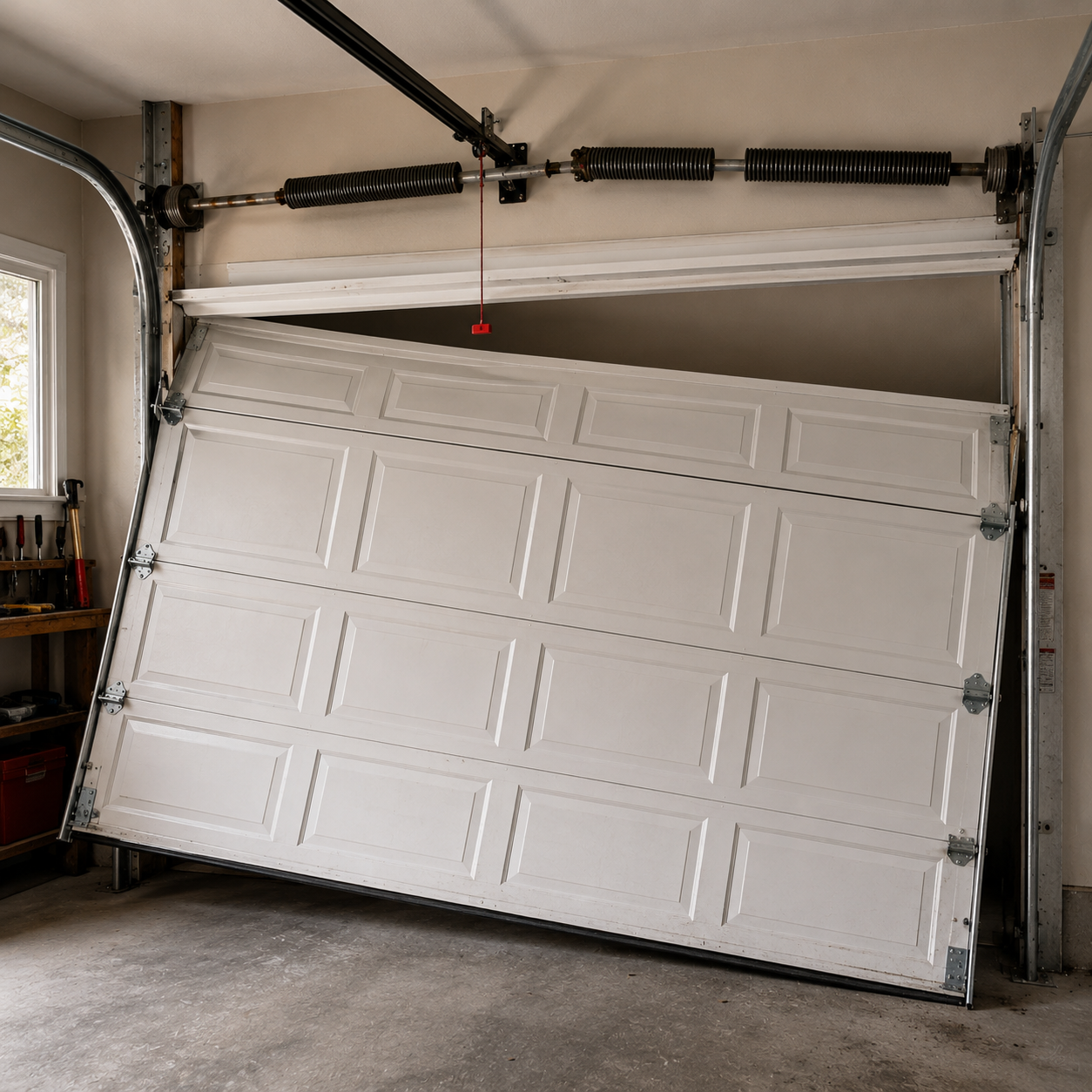
Quick Answer: A garage door that slams shut instead of lowering in a smooth, controlled way has almost certainly lost the counterbalance that holds its weight — most often a broken or badly weakened spring. The springs are what support the door's weight and let it descend gently; when they fail, gravity takes over and the door drops hard. Other contributors can be broken cables or a disconnected opener. This is a serious safety hazard, because a heavy door falling without its counterbalance can injure a person or pet and damage the door. If your door slams or drops fast, stop using it and keep people and pets clear until it's repaired.
A garage door should lower in a slow, controlled glide. When it suddenly slams shut — dropping fast and hitting the floor hard — that's not a minor quirk. It means the system that holds the door's weight has failed, and the door is essentially falling. This is one of the clearest signs of a dangerous garage door problem, and it calls for immediate caution.
How a Door Is Supposed to Lower
A garage door is heavy, and the reason it descends gently rather than crashing down is the counterbalance system. The springs store energy and offset the door's weight, so that as the door lowers, the springs control the descent and the opener simply guides it down at a steady pace. With the counterbalance intact, the door's weight is held in check the entire way down.
Take that counterbalance away, and nothing is holding the door's weight anymore. Gravity pulls it down with full force, and the result is a door that drops fast and slams into the floor. So a slamming door is, almost by definition, a counterbalance failure.
The Most Likely Cause: A Broken Spring
The leading cause of a door that slams shut is a broken or severely weakened spring. The springs do the heavy work of counterbalancing the door, and when one breaks, that support is lost. The door becomes its full, heavy self with little or nothing offsetting it, so it drops hard when lowered and is very difficult to lift by hand.
A broken spring often gives signs: the door suddenly feels extremely heavy, it may struggle or refuse to open with the opener, and a torsion spring may show a visible gap where it snapped. Many people hear a loud bang when a spring breaks. If your door started slamming after a noise like that, a broken spring is the prime suspect.
Other Causes to Consider
While springs are the usual culprit, a couple of other failures can cause a fast or uncontrolled descent. Broken or slipped cables, which work with the springs to support the door, can let the door drop if they fail. And if the opener has been disconnected from the door — for instance, the emergency release cord was pulled — the door is no longer being guided down by the opener and can fall freely if the springs aren't holding it. In most cases, though, a slamming door traces back to the springs no longer counterbalancing the weight.
| Sign | Likely cause |
|---|---|
| Loud bang, then door slams shut | Broken spring |
| Door very heavy to lift by hand | Spring failure |
| Visible gap in torsion spring coil | Broken torsion spring |
| Cable dangling or off the drum | Broken or slipped cable |
| Door falls after pulling release cord | Opener disconnected, no counterbalance |
Why This Is a Real Safety Hazard
A garage door is one of the largest and heaviest moving objects in a home, and a door without its counterbalance is a falling weight. If it slams down while a person, pet, or vehicle is underneath, the consequences can be serious. Even without anyone in the way, the repeated impact damages the door and its hardware. This is not a problem to "keep an eye on" while continuing to use the door — the danger is present every time the door is operated. A slamming door has lost the safety margin that makes a garage door safe to be around.
A garage door that slams shut has lost its counterbalance and can fall with enough force to cause serious injury. Stop using the door immediately, keep people, pets, and vehicles out from under it, and do not attempt to repair the springs or cables yourself — they are under extreme tension. This is an urgent repair for a trained technician.
What to Do Right Away
If your door is slamming shut, the safest immediate steps are to stop operating it and keep everyone clear of the doorway until it's fixed. Do not try to replace the springs or cables yourself; the tension involved makes that genuinely dangerous, and it's the single most common warning across garage door safety guidance. Instead, have a trained technician inspect and repair it. They can confirm whether it's a spring, a cable, or another issue, replace the failed parts with correctly sized components, and rebalance the door so it lowers safely and smoothly again. Because both springs on a two-spring door wear together, replacing them as a pair is often recommended to avoid a repeat failure.
Frequently Asked Questions
Because it has lost its counterbalance, almost always from a broken or badly weakened spring. The springs hold the door's weight and control its descent; when they fail, gravity pulls the door down with full force, so it drops fast and slams. A door that slams is essentially falling rather than being lowered, which is why it's a serious problem.
Yes, very. A garage door is heavy, and without its counterbalance, it can fall with enough force to injure a person or pet or damage a vehicle underneath. The hazard is present every time the door operates. A slamming door should be taken out of use immediately, with everyone kept clear of the doorway until it's professionally repaired.
You shouldn't. Continuing to operate a door that slams means risking it falling on someone or something each time, and it further damages the door and hardware. The safe choice is to stop using it, keep the area clear, and have it repaired. The counterbalance failure that causes slamming makes the door unsafe to operate until it's fixed.
Springs wear out with use — they're rated for a number of open-close cycles and eventually fatigue and break. Rust, lack of lubrication, temperature swings, and an unbalanced door all shorten their life. A spring often breaks with a loud bang, after which the door becomes very heavy and may slam shut because the counterbalance is gone. Springs are a normal wear item that eventually needs replacement.
It's strongly advised against. Garage door springs are under extreme tension and store enough energy to cause serious injury if they release suddenly during a repair. Replacing them safely requires specific tools and training. A slamming door from a broken spring is an urgent repair that should be handled by a trained technician, not attempted as a DIY project.
On a two-spring door, replacing both is often recommended. Both springs go through the same number of cycles, so when one breaks, the other is usually near the end of its life too. Replacing only the broken one frequently leads to the second failing soon after. Replacing both keeps them matched and the door balanced, reducing the chance of a repeat slam.
Treat a Slamming Door as Urgent
A garage door that slams shut instead of lowering gently has lost the counterbalance that holds its weight — usually a broken spring — and is effectively falling rather than closing. That makes it a genuine safety hazard every time it's used. Stop operating it, keep everyone clear, and have a trained technician replace the failed parts and rebalance the door. This is one garage door problem that shouldn't wait.
Garage door slamming shut or dropping fast — Stop using it and get the springs and cables repaired safely right away. Phoenician Garage Door & Repair serves Phoenix and the Valley. ROC #316471. Call (602) 610-0112.
