
Belt-Drive vs Chain-Drive Openers: Which Is Right for You?
Quick Answer: A belt-drive opener is quieter and needs less maintenance, ideal for attached garages near living spaces. A chain-drive is louder, cheaper, and proven for heavy doors, better for detached garages or tight budgets. Choose based on where your garage is, how much noise matters, and the door weight.
Standing in the aisle looking at two garage door openers that seem nearly identical on the box, the only obvious difference in the spec sheet is one word: belt or chain. They cost different amounts, they carry similar horsepower ratings, and both promise to open the same door. So the choice feels arbitrary until you understand what actually separates them, which comes down to one moving part.
Once you know what each mechanism is doing every time the door moves, the decision stops being a guess and starts matching the physical realities of your home: how heavy the door is, where the garage sits relative to the bedrooms, and how much upkeep you want to sign up for. This walks through the mechanism first, then the trade-offs, so you can match the opener to your situation rather than to whichever one happened to be on the end cap.
How Both Openers Actually Move the Door
Strip away the housing, and both opener types do the exact same job in the same way. A motor turns, and that motion drives a trolley (the sliding carriage) along a straight rail mounted to your ceiling. The trolley is connected to the door by an arm, so as the trolley travels down the rail, it pulls the door up and opens, then pushes it back down to close.
The only difference between the two designs is how the motor moves the trolley along the rail. Everything else, the rail, the trolley, the arm, the wall button, the safety hardware, is shared. So when you compare a belt against a chain, you are really comparing two answers to one narrow question: what pulls the carriage?
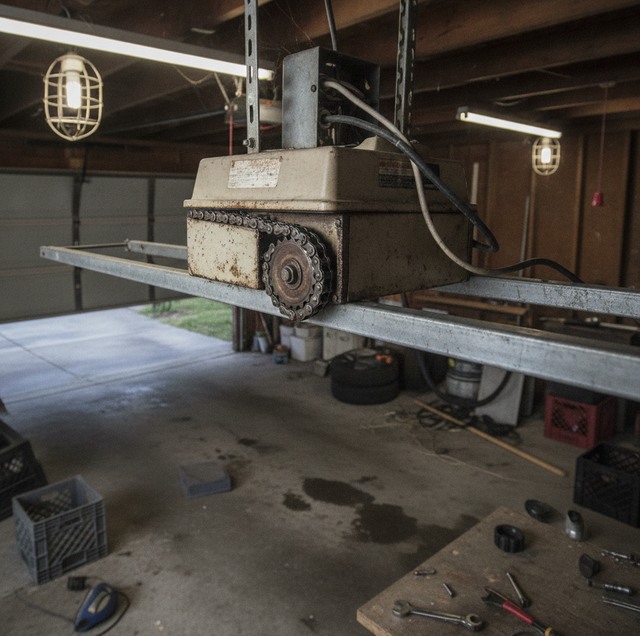
A chain-drive opener uses a metal chain, built much like the chain on a bicycle. Metal links loop around a sprocket at the motor and run the length of the rail, and as the sprocket turns, it feeds the chain and drags the trolley along. It is a mechanically simple, well-proven arrangement that has moved garage doors for generations, and that longevity is a real point in its favor.
A belt-drive opener swaps the chain for a reinforced belt. It looks like a wide rubber band, but it is engineered for the load, typically steel-corded or fiberglass-reinforced, so it carries the weight of the door without stretching. The belt loops the same way a chain would, but because it is a continuous flexible band rather than a series of metal links, the way it moves feels different the moment you hear it run.
Why the Chain Is Louder
The noise difference is not marketing; it comes straight from the materials. A chain is a metal running against a metal sprocket and metal rail guides. Every link that engages the sprocket produces a small impact, and hundreds of those impacts per cycle add up to the familiar rattling, clattering sound and the vibration that travels through the rail into the ceiling framing and the rooms above.
A belt has none of that metal-on-metal contact along its run. The flexible band glides rather than clatters, so it produces markedly less vibration and a much lower, smoother sound. For a garage that sits away from where anyone sleeps or relaxes, that difference may not matter at all. For a garage tucked under a bedroom, it can be the deciding factor.
Where Each One Fits Best
Here is how the two stack up on the factors that tend to drive the decision:
| Factor | Chain-Drive | Belt-Drive |
|---|---|---|
| Noise | Louder, noticeable rattle and vibration | Quiet, smooth, minimal vibration |
| Upfront cost | Lower | Higher |
| Maintenance | Periodic lubrication and tension checks | Little upkeep |
| Heavy or oversized doors | Long, proven track record | Handles most residential doors; very heavy loads may call for a heavy-duty belt |
| Best placement | Detached or garages away from the living space | Attached garages, bedrooms, or rooms nearby |
Read down that table, and a pattern shows up. A chain earns its keep when the garage is detached or set apart from the living areas, when the budget is the priority, or when the door is unusually heavy, and you want a mechanism with the longest track record under load. The noise is far less of a concern when there is a wall or a stretch of yard between the opener and anyone trying to sleep.
A belt earns its keep when the garage is attached, and there are bedrooms or living spaces over or beside it. The quieter operation is the whole point, and the lighter maintenance is a bonus for anyone who would rather not think about the opener between service visits. You pay more at the outset in exchange for that quiet and that lower upkeep.
What the Two Designs Share
It is easy to overstate the gap. Both belt and chain openers come in comparable horsepower classes, so the drive type is not what determines whether an opener can handle your door. Both are increasingly built around DC motors that ramp up and slow down gently at each end of travel, so the door starts and stops without the jolt older openers gave it, and that soft start and stop runs smoothly whether a belt or a chain is doing the pulling.
The modern conveniences are shared too. Battery backup so the door still opens during a power outage, and smartphone control so you can check and operate the door from an app, are add-on features available on both drive types rather than something exclusive to one. Choosing a belt over a chain does not gain or cost you any of those.
Most importantly, the safety hardware is identical. Both rely on the same photo-eye sensors near the floor that stop and reverse the door if something crosses the beam, the same auto-reverse behavior, and the same springs and cables doing the real lifting work. The opener only guides the door; the counterbalance springs carry its weight. That is why the drive type has nothing to do with how safe the system is.
There is also a third design worth naming so you know the full menu: the screw-drive opener, which uses a threaded steel rod instead of a belt or chain. It is a legitimate option with its own trade-offs, but it sits outside this comparison, which is squarely belt against chain.
Making the Call
If your garage is attached and shares a wall or ceiling with a bedroom, an office, or a living room, lean belt. The quiet operation is exactly what that layout needs, and you will notice it early every morning and late every night when the door runs.
If your garage is detached, or noise simply is not a concern where it sits, or you are working to a tighter budget, a chain is a sound choice with a long history behind it. And if your door is on the heavy or oversized end, whether a solid wood carriage door or an extra-wide double, that is a conversation to have with an installer, because the right match may be a chain or a heavy-duty belt rated specifically for the load rather than a standard residential unit.
One thing to keep out of the do-it-yourself column: the installation itself, and anything involving the springs. The counterbalance springs are under extreme tension and store enough energy to cause serious injury if they let go, so adjusting, repairing, or replacing them is work for a trained technician, not a weekend project. Mounting the opener, setting the travel limits, and aligning the safety sensors are all part of a proper install as well. Picking the opener is the part you own; getting it on the ceiling safely is the part to hand off.
Frequently Asked Questions
Yes. The reinforced belt runs without the metal-on-metal rattle that a chain produces as its links engage the sprocket, so it operates markedly quieter and smoother. That is the main reason a belt is the usual pick when a bedroom or living space sits directly over or beside the garage, where every cycle would otherwise be heard through the ceiling or wall.
Not necessarily. Modern reinforced belts are steel-corded and rated to last many years, and they need less maintenance over that lifespan than a chain does. The one caveat is load: a very heavy or oversized door may still be matched to a chain or to a heavy-duty belt built for that weight, rather than a standard belt, so the door itself guides the choice more than the material's durability does.
Yes. A chain needs periodic lubrication and occasional tension adjustment to keep running quietly and smoothly, since a dry or loose chain gets louder and rougher over time. A belt runs with very little upkeep by comparison, which is part of its appeal for anyone who would rather not schedule regular opener maintenance between professional service visits.
The drive type matters far less than the motor behind it. Both belt and chain openers come in comparable horsepower classes, and a DC motor with soft start and stop opens the door smoothly and quietly, regardless of whether a belt or chain is pulling. The practical takeaway is to match the motor strength to the door's weight rather than assuming one drive type is inherently more powerful.
A chain has the longest track record on heavy and wide doors, which is why it is often the default recommendation there. Heavy-duty belts handle the great majority of residential doors without trouble, but an unusually heavy carriage or a solid wood door is often paired with either a chain or a reinforced belt specifically rated for that load, so an installer sizes the mechanism to the door rather than the other way around.
Yes. Both use the same photo-eye safety sensors that stop and reverse the door if something breaks the beam, the same auto-reverse behavior, and the same manual release cord for opening the door by hand. Both can also add battery backup and smartphone control. The safety and convenience features do not depend on which drive you pick, so that side of the decision is a wash.
Ask about a quieter, right-sized opener for your door — so you get the fit and the peace of mind without the guesswork. Phoenician Garage Door & Repair serves Phoenix and the Valley. ROC #316471. Call (602) 610-0112.
