
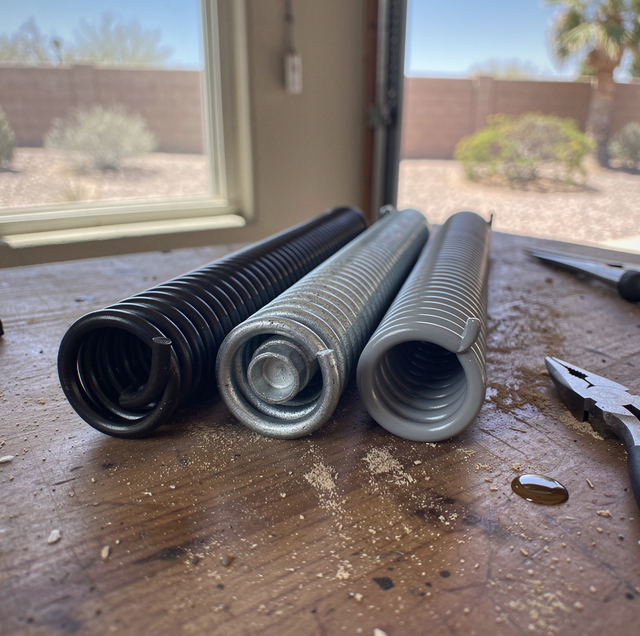
A torsion spring leaves the factory in one of three finishes: bare black oil-tempered steel, a zinc-galvanized coating, or a baked powder coat over the wire. It's easy to assume that a coated spring, since it resists rust, must also hold up better in summer heat than a plain one. That assumption conflates two separate jobs: one done by the finish and one by the steel beneath it. The comparison below sorts the three finishes on rust resistance, fatigue life, upkeep, and look:
| Factor | Oil-Tempered (Black) | Galvanized | Powder-Coated |
|---|---|---|---|
| Corrosion resistance | Lowest; bare steel pits and rusts if the coil stays damp or dusty | Higher; the zinc layer sacrifices itself to protect the steel underneath | Higher; the painted barrier layer resists surface rust while it stays intact |
| Fatigue life (set by cycle rating, not coating) | Set by the wire's diameter, its coil length, and its tempering | Same as an oil-tempered spring of the same rating; some galvanized springs can relax slightly after installation and need their tension re-set | Same as an oil-tempered spring of the same rating |
| Lubrication needs | Needs periodic lubrication to limit friction and slow rust | Still needs lubrication; the coating doesn't replace it | Still needs lubrication; the coating doesn't replace it |
| Look | Dull black or dark gray | Bright, slightly dull metallic gray | Solid or semi-gloss color coat |
The fatigue-life row decides how long a spring lasts under normal use, and apart from that tension re-set, it reads the same for all three finishes once the cycle rating, wire size, and coil length match.
What Wears a Spring Out: Cycles and Fatigue
Every time a torsion spring winds and unwinds through a full door cycle, the steel flexes under tension and releases it again. Do that enough times, and microscopic cracks form inside the coil, starting at points of highest stress and slowly growing until the spring gives way, letting go with a loud crack rather than a slow leak of tension. That process, called metal fatigue, is driven by how many cycles the spring completes and how much load it carries on each one, factors set when the spring is manufactured: the diameter of the wire, the length of the coil, and the heat-treating process that hardens the steel. None of that changes based on whether the finished spring is left bare, galvanized, or powder-coated. A coating is a layer applied over the finished wire; it plays no role in how that wire was hardened or how thick it is, so it has no direct effect on how many winding cycles the coil can survive before fatigue ends it.
What a Coating Protects Against
A galvanized coating is a layer of zinc bonded to the steel wire, and a powder coat is a baked-on layer of colored resin. Both work the same way on a spring as they do on any other steel part: they form a barrier between the wire and moisture, dust, and open air, which slows the surface rust that would otherwise start pitting the coil over time. That corrosion resistance is real, and it matters for a coil mounted where dust and grit can settle and hold moisture against the wire. What a coating doesn't do is change the steel's tempering, its wire gauge, or its cycle rating. A galvanized spring rated for the same cycle count as a bare oil-tempered spring is not a stronger spring underneath the coating, and it will not out-cycle that spring in dry conditions where corrosion was never the limiting factor to begin with.
Heat and Spring Wear
Heat does not make a coated spring outlast a bare one. A torsion spring's fatigue life is set by its cycle rating and its wire (diameter, coil length, and tempering), and the temperature inside a garage does not affect any of those. A galvanized or powder-coated finish is a surface layer whose job is corrosion, so it adds nothing on the fatigue side in a hot garage or a cool one. The place heat does reach a spring is its lubricant, which breaks down faster as temperatures climb, leaving a dry coil with no film between coils that rub on every cycle. That is an upkeep matter, and it applies equally to all three finishes. A coated spring bought for a hot garage buys rust protection, which has value where moisture or dust reaches the coil, and nothing more.
Cycle Ratings Matter More Than Finish
A spring's cycle rating is set at the time of manufacture and communicated through a stamped or color-coded marking near the winding cone, the same system used across all three finishes. A higher-rated spring is built from heavier wire or a longer coil to reach more cycles, and two springs with the same rating, wire diameter, and coil length reach that count together whether one is bare and the other is galvanized or powder-coated. The one way a coating changes the outcome is indirect: rust pitting on a bare or damaged coil concentrates stress at the pit, and a corroded coil can fail well short of its stamped rating even though the underlying design was sound. A coating that's holding up slows that pitting from starting in the first place, which is a real advantage in a damp or corrosive environment, separate from anything to do with cycle count itself.
Lubrication and Upkeep
None of the three finishes changes how a spring should be maintained. Every torsion spring needs periodic lubrication to keep the coils moving against each other smoothly and to limit the friction that adds its own wear on top of normal cycling. Dust and grit that work into the coil can combine with dried-out lubricant into a gritty paste that adds friction and traps moisture against the wire, undermining a coating's rust protection from the inside rather than the outside. A technician checks and re-lubricates the coil during a routine inspection regardless of finish, and inspects the winding cones and bearing plates for wear at the same time, since those parts see friction unrelated to the spring's coil finish.
A torsion spring holds enough stored tension to cause serious injury if it lets go while someone works near the shaft. Winding, unwinding, or replacing a spring of any finish is for a trained technician, never a homeowner.
Matching a Replacement Spring to the Door
When a spring needs replacing, the finish is a secondary decision behind getting the rating right. The rating, the wire diameter, and the coil length all have to match the door's weight and expected use: a spring that's undersized for the door overworks the opener regardless of how it's coated, and one that's oversized can make a door feel like it wants to float open. Whether one spring or both are replaced depends on the wear observed on the surviving spring, and the coating type plays no part in it. Once the rating and dimensions are correct, coating becomes a question of environment. A coil that sits in a damp, dusty, or exposed location benefits from the corrosion resistance provided by a galvanized or powder-coated finish, while a coil in a dry, sheltered garage may see little practical difference between finishes over its working life.
Frequently Asked Questions
Yes. A two-spring shaft works correctly as long as both springs match on wire diameter, inside diameter, and coil length and are correctly handed, one left-wound and one right-wound; the coating on each side doesn't have to match, since it plays no part in how the springs share the load.
It can. Where a powder coat is chipped or scraped through, moisture can creep under the film at the edge of the break, so rust can spread beneath a surface that still looks intact from the garage floor.
No. A coating doesn't change the noise. A dry coil can creak as its coils rub, and the winding cones, the lift-cable drums and the bearings the shaft turns in add their own sounds, so a noisier spring calls for lubrication or an inspection, not a different finish.
No. A wound spring stays under tension the whole time it sits on the shaft, so it's not something a homeowner should handle or coat. A brushed or sprayed coat on a working coil can also crack and flake as the coil flexes, leaving a patchy film that can trap moisture instead of keeping it out.
No. The bars sit in the winding cone at the end of the spring, not on the coil, so the number of turns and the method remain the same for all three finishes. What a technician does watch on a coated spring is chipping at the cone and set screw, where bare steel would be exposed.
No. A galvanized or powder-coated spring bolts into the same center bracket, bearing plates, and winding cones as an uncoated one, since the coating is a treatment on the wire, not a change to the spring's dimensions. Replacing one finish with another at the same rating doesn't require any hardware changes beyond the spring itself.
Ask for a torsion spring replacement matched to your door — technicians size the wire, inside diameter, and coil length to the door's weight, then fit the finish your garage conditions call for. Phoenician Garage Door & Repair serves Phoenix and the Valley. ROC #316471. Call (602) 610-0112.