
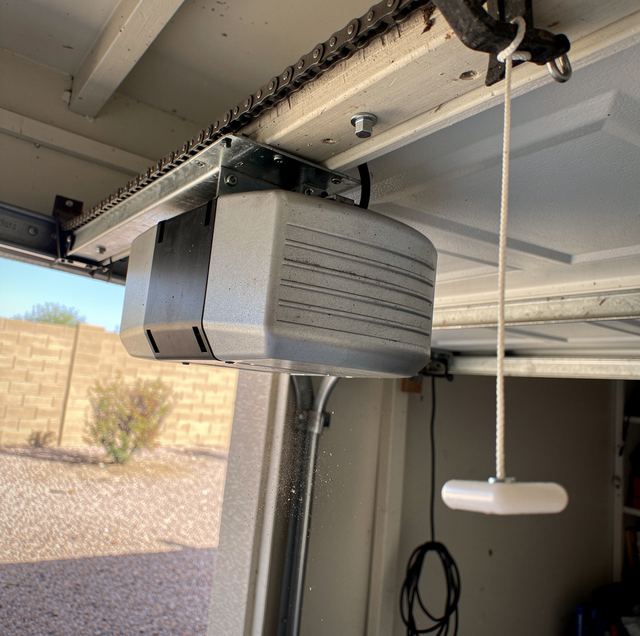
Same button, same door, same routine, and it works every single morning. By two or three in the afternoon, it does something different: a click and nothing, a hum and nothing, or total silence. By the time you're pulling in after dinner, it opens like nothing was ever wrong. Most people file this under "acting up" and wait for it to get worse. It's worth treating differently, because a fault that shows up in the same few hours and clears on its own by evening isn't behaving randomly at all. It's crossing a threshold and then dropping back under it, and the part of the system doing the crossing is exactly what the clock is telling you.
Nothing about a garage door opener is designed to care what time it is. What it cares about is temperature, and different components inside it reach their own limits at different points in the afternoon.
Where the Heat Reaches First: The Motor's Own Shutoff
The motor that drives a residential opener almost always carries a built-in thermal overload switch wired directly into the winding circuit. It's a safety part, not a defect: as current flows through the copper wire under load, the winding heats up, and past a set point, the switch opens the circuit before the heat damages the wire's insulation. The motor doesn't die when this happens. It goes quiet, cools against the surrounding air, and once the winding drops back under that same threshold, the switch closes again on its own, and the opener works as if nothing happened.
This is almost always the first mechanism a hot afternoon trips, because the motor is the component doing continuous work under load rather than just sitting in the heat. It's also the fastest to recover, typically resetting within fifteen to thirty minutes once the housing has had a chance to shed heat. If your door quit mid-lift on a triple-digit afternoon and started working again well before dark, this switch is the most likely explanation, and it isn't something a technician needs to replace. It's doing its job.
The Logic Board Feels the Heat Next, and Recovers Less Cleanly
Mounted inside most openers is a circuit board that reads the remote signal, runs the safety logic, and tells the motor when to start and stop. Two things on that board respond to heat in ways the motor doesn't. The first is the board's electrolytic capacitors, which store the burst of current the motor needs to start turning. Heat is the single biggest factor in how long a capacitor lasts, but it works on a slow clock: hot month after hot month bakes moisture out of the electrolyte, so a capacitor that started June healthy can be sitting close to its margin by September, which is when it begins showing up as a motor that hums or needs a second try before it moves. That is a season's worth of wear, and it does not arrive and clear with the afternoon. The second is the board's own components, the solder joints and semiconductor junctions that were never rated for the air temperature near a garage ceiling in the hottest part of the day. Those do track the afternoon: a junction drifts outside its spec window while the board is hot and comes back when it cools, and a solder joint that has been heat-cycled for years can open on expansion and close again on contraction.
The reason this matters for diagnosis is the recovery pattern. A thermal switch resets on a predictable clock. A stressed board doesn't. It may come back the moment things cool, keep glitching well into the evening, or work erratically instead of cleanly failing and cleanly returning. If your door's afternoon trouble doesn't clear on any consistent schedule, the board and its capacitors, not the motor's overload switch, are the more likely suspects.
Grease Thins Before the Door Ever Feels Sluggish
Heat doesn't only act on electronics. Rollers, hinges, and the curved section of track carry a film of white lithium grease, and heat pulls that film thinner. What clung to a roller stem at seven in the morning is running loose by mid-afternoon, and a loose film gets squeezed out from between the surfaces that are actually rubbing. None of this is visible from the driveway. The door can look and sound normal while the actual friction it's fighting climbs through the hottest part of the day.
That extra friction doesn't stop the door on its own. It raises the load the motor has to overcome on every single cycle, right at the hours when the motor's own thermal margin is already thinnest from the heat around it. A door with dry, heat-thinned lubrication asks more of a motor that already has less to give, which is exactly the kind of combination that pushes a marginal afternoon into a tripped overload switch that a well-lubricated door, in the same heat, might never reach. The lubrication problem and the motor's thermal cutoff aren't separate stories. One quietly sets up the other.
The Photo-Eyes Fail for a Completely Different Reason
The safety sensors near the floor run into afternoon heat trouble too, but through a mechanism that has nothing to do with a motor or a board overheating, which is why it's easy to misdiagnose as the same problem. Two things happen to the photo-eyes specifically as the day heats up.
The first is physical. The metal or plastic brackets holding each sensor expand slightly as they absorb heat through the afternoon, and because the infrared beam between the two eyes is a narrow column that has to land squarely on a small lens, a shift measured in fractions of an inch is enough to walk the beam off its receiver. The bracket isn't broken. It's simply moved by the same heat that's stressing everything else on the door, and it typically settles back into alignment as the metal cools overnight.
The second is optical, not thermal in the mechanical sense at all. As the sun drops lower in the sky throughout the afternoon, its angle can align close to level with the doorway and shine nearly straight into the receiver's eye lens. A receiver flooded with that much direct light can't distinguish the sender's beam from the surrounding glare, and the door interprets the failure as an obstruction and refuses to close. This has nothing to do with dust, wiring, or a failing part, and it clears the moment the sun's angle changes, not when any component cools down.
Shade the receiver lens without crossing the beam: hold a card an inch above the lens, angled to cut the low sun off it. If the door closes with the beam still clear, sun angle is the cause, not the hardware.
Reading the Recovery Window, and When It Stops Resetting
| Mechanism | Typical recovery pattern | What it tells you |
|---|---|---|
| Motor thermal-overload switch | Resets in about fifteen to thirty minutes once the housing cools | A working safety feature, not a failure |
| Logic board or capacitor stress | No fixed window; may stay erratic well past dark or fail to clear at all | A component is degrading, not just overheating |
| Heat-thinned lubrication | Eases as the door's own friction drops with the evening temperature | The motor is fine; the door is harder to move at peak heat |
| Photo-eye sun washout | Clears the instant the sun's angle shifts, unrelated to ambient temperature | A light problem that happens to occur in the afternoon |
The trouble starts when that window stops holding. A thermal switch that used to reset in twenty minutes and now takes until well after sunset has likely been opening and closing thousands of extra times across repeated hot seasons, and switches built for occasional cutoffs wear at their own contacts the more often they're forced to work. A capacitor that carried the door through last summer and now leaves the motor humming even in cooler morning air has crossed from heat-worn to failing. An intermittent heat fault becomes a permanent one exactly at the point where the recovery time stops being predictable, and that's the signal that a part needs replacing rather than a few more hot afternoons of patience.
Frequently Asked Questions
Often, yes. A garage ceiling under a sun-facing roof absorbs radiant heat from the roof deck above it, not just the surrounding air, and the hottest air in the building collects right there at the top, well above both the outdoor reading and the air down at floor level in the same garage. An opener mounted there is working in air noticeably hotter than whatever a thermometer on the wall outside would show.
It can contribute. On the hottest days, high air-conditioning demand across the entire grid can cause a brief sag in utility voltage during peak hours. A motor or logic board already running close to its thermal limit has less tolerance for that kind of sag than the same component would have on a cooler, lower-demand day, so a voltage dip that would go unnoticed in spring can be the difference that tips a marginal afternoon into a shutdown.
Consecutive hot days matter more than any single day's high temperature. A motor housing and logic board that never fully cool overnight after several triple-digit days in a row start the next afternoon already carrying stored heat, so they reach their trip point earlier than they would after a cooler night resets the whole system. A single hot day following milder weather has more thermal margin to work with than the third or fourth day in a row.
Not meaningfully. The opener sits at the ceiling and is exposed to that heated air whether the door is open or closed, so position alone doesn't shield it. Running extra open-and-close cycles to "beat the heat" actually increases motor runtime, which adds its own heat on top of what the room is already producing.
Not automatically, and sometimes the opposite. A smart opener's board carries a radio and a microcontroller that older relay-based boards never had, and both generate heat while running, adding to the load the board already has to shed in a hot garage. Age isn't the deciding factor here; component density on the board is.
It's worth having checked. A force setting calibrated in spring assumes the door's friction level at that time, and if lubrication has thinned and migrated repeatedly over a hot season, the true friction the motor is fighting by late summer can be higher than the setting was tuned against. A setting that was safely calibrated in cooler months can end up running the motor closer to its limit without anyone having changed a thing.
Schedule a heat-season opener check — catch a thermal switch, a stressed board, or thinned lubrication before it strands you at the worst hour. Phoenician Garage Door & Repair serves Phoenix and the Valley. ROC #316471. Call (602) 610-0112.
