
Full-View Glass Garage Doors: What Holds Up in Intense Heat
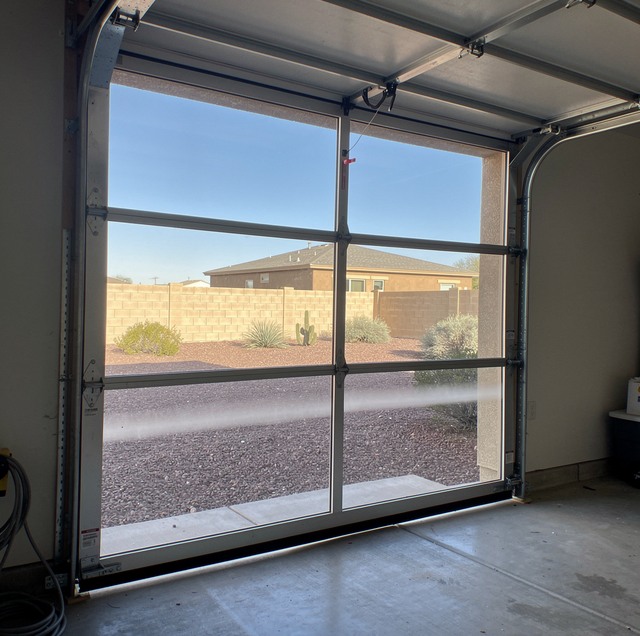
You put your hand on the aluminum stile at four in the afternoon and pull it back faster than you meant to. The glass beside it is warm, and warm is all it is. The metal frame holding that glass is something else, and if you stand in your garage with the door closed past a hundred and fifteen, you feel two materials running at different temperatures three inches apart.
What you feel there runs the whole aging story of these doors. The parts you notice first are almost never the parts that keep your door square, and knowing which is which changes what you ask for, what you refuse, and what you should expect your installer to spec for you.
The Marks a Full-View Door Shows After One Hot Summer
Walk a glass door in September, and the marks arrive in a predictable order. The painted face of the rails goes flat before it goes chalky. A film settles inside the glass where nobody wipes. The bottom seal loses its spring and no longer presses against the slab. And in the last foot of lift, the door gets heavy in a way it was not in March.
Those four symptoms belong to four different systems, and only one of them is cosmetic. The flat paint is a finish problem. The film is a glass and sealing problem. The hardened bottom seal is a gasket problem. The heaviness is a counterbalance problem, and it is the only one that can hurt somebody.
That ordering matters more on a full-view door than on a steel one, because a glazed door carries more weight in a lighter structure and hides less of its own movement. When you can see through a panel, you notice the film and the dull frame every day. You do not notice the spring working harder until it stops working.
Symptom, Cause, and What It Actually Points To
Work the table below from the middle column, not the first. Two symptoms that look nothing alike can share a cause, and two that look identical can come from opposite ends of the door. Sorting them this way keeps you from replacing a gasket when the change happened at the spring.
| What you see or feel | What is actually changing | Where it points |
|---|---|---|
| Frame color flattens, then chalks | Coating losing gloss and pigment under ultraviolet load | Finish specification, not damage |
| Haze or streaking inside the glazing | Sealing and glazing detail at the panel edge | Installation and the glazing system |
| Bottom seal stays crushed and lets daylight in | Gasket compound hardened past its recovery point | Air infiltration and seal replacement |
| Door drags through the last foot of lift | Counterbalance no longer matched to the door weight | Torsion spring sizing, a technician job |
| Opener straining on an otherwise quiet door | The same counterbalance change, seen from the motor | A balance check before any opener work |
Only the bottom two rows carry urgency. A chalked frame will still be a chalked frame next spring. A door whose counterbalance has drifted is putting load through a spring, a cable, and a bracket sized for a different number, and that drift turns a glazed panel into something heavy enough to injure a person.
What Bakes Hardest on a Full-View Door, the Glass or the Frame?
Neither, exactly. They take the heat by different routes, and the glass is the one with a published number attached. Federal guidance on buying energy-efficient windows, doors and skylights explains the number plainly: it measures how much heat a pane transmits, on a scale from 0 to 1, where a lower number means less heat gets through.
The same guidance gives the direction that matters in a hot climate: in a warm climate, where cooling costs are the concern, choose a lower number on that scale to cut unwanted heat gain. An efficiency-rating program bases its criteria on independently certified ratings that vary by climate zone, a certification written for windows and skylights, not for sectional garage doors.
None of that changes after the door is hung, and the same guidance names the lever that moves it: a coating that blocks specific wavelengths of light, rather than tinting the glass evenly, cuts summer heat gain and cooling costs without noticeably dimming the glass or changing its color. A door glazed clear for the showroom carries that number for life. Ask before the panels are made.
What Bakes a Painted Finish Loose While an Anodized One Holds?
Both finishes are on offer here. One glazed aluminum door model is available in powder coat paint or anodized aluminum, and those are not two colors of one thing. Powder coat is an organic film baked onto the surface, carrying pigment and resin that ultraviolet light works on directly. Anodizing converts the outer skin of the aluminum into an oxide layer, with color held inside the pores instead of sitting on top.
Organic coatings carry a published durability tier, and the top one is demanding. The industry standard for that top tier requires a ten-year South Florida outdoor exposure test, judged on fade resistance, chalk resistance and gloss retention, on top of salt-spray and humidity requirements. Ten years of real sun, not a lamp in a cabinet. A coating certified to a lower tier is not defective. It was tested against less.
Anodized aluminum ages differently because there is no surface film to lose adhesion to. Its slow failure is fading and, in the wrong chemistry, pitting, and neither looks like peeling paint. Choosing between them is a question about exposure and upkeep.
Weight Is the Load Heat Never Lifts
Heat gets the attention and weight quietly does more. A glazed aluminum door weighs more than a steel sectional across the same opening, and the opening itself has to be built for it. Manufacturer specifications are explicit about this: adequate header support and reinforced side jambs are required to safely handle the weight of aluminum and glass components, because proper framing prevents long-term alignment issues. Both of those are ordering-stage requirements, not maintenance items, and neither one can be added later without opening the wall.
The counterbalance follows from the same weight. Properly sized torsion springs are required to balance a glazed door's weight, and a higher-cycle spring, rated near 25,000 cycles, is available for high-use garages to extend the system's service life, giving close to twice the life of a standard torsion spring. Heat does not change that sizing arithmetic at all.
None of that sizing is a homeowner adjustment, and the reason is mechanical rather than legal. A torsion spring on a full-view door holds enough stored energy to drive a winding bar out of a hand, and a spring chosen for a lighter door carries that energy at the wrong rate for the load hanging above it.
Winding, unwinding, or re-tensioning the torsion spring on a glazed door, and re-using an existing spring on a heavier glass door, both belong to the installing garage door technician who alone sizes and winds the counterbalance, never to you.
Sealing, Air Infiltration, and the Gap You Can See at Noon
Glass panels are set and sealed, not dropped in. Manufacturer requirements state that glass panels must be handled and installed carefully to maintain safety and durability, and that professional installation ensures proper sealing, alignment, and long-term performance of the glazing system. Sealing is where a glazed door holds its line for a decade or leaks air by its second summer.
The handling half of that requirement is the part that injures people. A single glazed section is heavy, and every edge of it is glass. The installation crew that sets and seals those sections works them in pairs with lifting gear, which is why walking a glazed section into the tracks alone, or pulling a cracked panel out of its section yourself, is a crush and laceration risk rather than a chore.
Sealing performance is also measurable, and one of these doors publishes a figure. A frameless glass model on the market reports meeting the relevant air infiltration requirements, with a third-party-tested value of less than 0.4 cfm/ft2. Treat that as a tested result on a product, never as a target your garage must hit.
What to Ask Before the Door Is Ordered
Three things are fixed the day the order goes in and expensive to change afterward: the glazing and its solar heat gain number, the finish and the tier it was tested to, and the framing and counterbalance sized for the finished weight. Everything else on a glass door is serviceable.
A showroom sample can show you color, edge detail, and how the glass looks lit from behind. It cannot show you ten summers of ultraviolet on that coating, or the load the panel puts through a spring at year six.
Frequently Asked Questions
Tinting changes the fraction of solar radiation the glazing lets through, which is the quantity a solar heat gain coefficient describes. How far a given tint moves that number for your opening depends on the exact glazing build, so ask for the rated figure on the panel you are buying, not the one you remember from a display board that never faced your opening.
Not in any way you would notice on your door. Both finishes sit on aluminum, and the metal beneath affects how quickly the frame takes up heat and how hot you find it by mid-afternoon. The finish choice is about how your surface looks after a decade of UV exposure, not how it feels on a hot afternoon.
It can, and the size of that effect depends more on the glazing specification than on the fact of glass. A large glazed opening facing direct afternoon sun admits more solar energy than an insulated steel panel over the same area. How much more depends on the glass build you specified for your opening, which is why the rated number belongs on your order sheet, not on a list you check afterward.
More often than most owners expect, and the reason is airborne grit as much as heat. Rinsing the frame and glass clears the abrasive film that settles on the rail faces and works into your coating every time you run the door. A quarterly rinse with plain water and a soft cloth keeps you ahead of it, and your glazing seals will last longer for it.
They can, and the upgrade is a technician visit, not a retrofit kit you order online. The higher-cycle springs the manufacturer offers at order time can be fitted afterwards, provided the replacement is sized to the real weight of your door and not to a generic chart. That sizing is the whole point of the visit, and it is also why springs on a glazed door are not an interchangeable part you can swap on a weekend with your own hand tools.
The crack, and it is not close. A dull frame is a finish aged past the tier it was tested to, and nothing about it changes the load path or your safety, so it can wait for a repaint or a panel swap whenever that suits you. A cracked glazing panel is different because the glass is structural within its section, and a crack changes how that section carries and releases energy when the door moves. Have a technician look at the cracked section before you keep cycling your door, and keep your hands off the panel while you wait, because pulling a failed piece of glazing out of its frame is how people get cut.
Get a full-view glass door planned for the sun it will actually face — so the framing, the finish, the glazing and the counterbalance are chosen together by a technician who has watched a decade of heat work on each of them. Phoenician Garage Door & Repair serves Phoenix and the Valley. ROC #316471. Call (602) 610-0112.
