
Belt-Drive vs Screw-Drive Openers: The Rod Runs on Grease
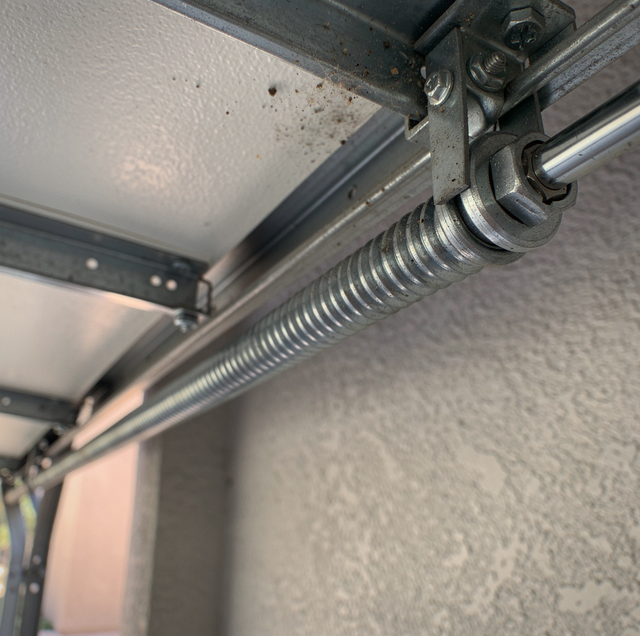
Stand under the rail with the door running, and the difference is visible from the floor. On a belt drive, you watch a loop travel, and the trolley travels with it. On a screw drive, one part travels, and nothing else does: a threaded steel rod spins in place for the whole cycle, and the carriage riding the thread is what moves down the rail, carrying your door arm with it. The sound splits the same way. One is a loop passing over a wheel; the other is a continuous whir with no beat. Two ways of getting force from a motor into a door, and only one of them relies on grease to do it.
How a Threaded Rod Moves the Trolley
A belt and a chain do the same job the same way: pulling. Both are tension members. The motor turns a wheel at one end, the loop runs the rail and back, and the trolley is dragged along by whichever half is loaded. Everything follows from that tension. The loop has to be tight enough not to slip or slap; it stretches with age and load, and it needs re-tensioning.
A screw drive has no tension member in it at all. The motor's output turns one threaded steel rod that runs the length of the rail, and the rod turns in place. It never travels. Riding the thread is a drive nut, a block bored and threaded to match the rod, and your door arm hangs off the carriage that block is part of. One revolution of the rod walks the nut along it by exactly the lead, the axial distance from one thread crest to the next. That is the whole conversion: rotation into straight-line travel, with nothing pulled and nothing looped.
The load path changes with it. When your door resists, nothing stretches. The reaction runs along the rod's axis into a bearing at the end of the rail, and the rail carries it from there. There is no slack because nothing in the drive is meant to be taut. The short parts list follows from that, and it is the honest advantage you are buying.
The Lubricant Sits Inside the Force Path
On a chain, the links carry the load in tension, and sliding happens only where each pin turns in its bushing as the chain wraps the wheel. Oil there cuts wear and noise. Let it dry out, and the chain gets loud and wears faster, but it still pulls your door, because pulling was never the oil's job.
A screw transmits its force elsewhere entirely: across the sliding contact between the rod's thread flank and the nut's matching flank. Every pound your door resists is carried through that sliding interface. How much of the motor's torque reaches the door, and how much turns into heat at the contact, follows the lead angle and the friction coefficient at those flanks. The grease supplies that coefficient. It is not sitting beside the mechanism, reducing wear. It is one of the terms.
Friction on that rod does work in the other direction too. A screw whose lead angle is below the friction angle at its thread will not turn when the nut is pushed along it, so the carriage stays where the motor left it rather than back-driving under the arm's load.
Upkeep on a screw drive is a different question. On a belt you can neglect lubrication indefinitely; there is nothing there to lubricate. On your screw drive, the film is a working component with a specification, and it is the one part of the drive train whose properties change with room temperature.
What Changes With Temperature, and What Does Not
In an unconditioned garage, one charge of grease can sit near 45 degrees on a winter morning and past 115 on a summer afternoon.
Start with what does not change on your rail. The rod is carbon steel, which grows about six and a half millionths of its length per degree Fahrenheit. An eight-foot rod is 96 inches, so a 70-degree swing lengthens it by 96 times 0.0000065 times 70, or about four hundredths of an inch. Your travel limits never see it. The lead does not change either. It was cut into the rod.
The grease is the other story, and the data sheet for whatever you use has the numbers. Kinematic viscosity is measured at 40 and 100 degrees Celsius under a standard test method, and the viscosity index is calculated from that pair under a companion standard, describing how steeply the oil thins between them. A higher index means a flatter curve. Consistency is graded by cone penetration under a standard test method and printed as an NLGI number. Your rod wants a small gap between those points: a film that is right at seven in the morning and thin by three has been right for half the day.
The dropping point is something else, measured by its own standard test: the temperature at which the thickener releases its oil altogether, which a garage does not reach. What a heat-stalled opener is doing in the moment it quits is a diagnostic question, and not this one. This one is about what the mechanism asks for first.
Blown Grit Collects Where the Film Is
The film does not stay where you put it. The nut sweeps the thread every cycle, pushing grease ahead of itself and leaving the flank behind it wiped to what stayed in the root. Soft grease moves further per pass, so a film thinned by heat reaches the ends of travel faster than a firm one. Put a flashlight on your own rod and look for the pattern: a ridge near the header end, another near the powerhead, and a clean stripe between them. The middle is where the film thins first, and it carries the same load as the ends.
It does not stay clean either. A screw drive keeps a sticky horizontal surface at ceiling height in a room whose door opening faces outdoors and opens several times a day. Dust settles onto the film, and the nut works it in. On a chain, grit falls through the links; on a belt there is no film for it to land in. On a rod, the film is the collector, and the load-carrying nut grinds it into the flanks.
That changes what re-greasing your rail means. Fresh grease over a grit-loaded film packs the abrasive deeper instead of flushing it. The rod is wiped first along its length and into the thread root, with the opener unplugged so nothing can cycle while a hand is on the rail. If yours has never had the old film taken off, last spring's coat sits on everything the rod has collected.
The Parts a Screw Drive Does Not Have
Count the drive train on your own screw unit from the motor out, and the list is short. The motor's output shaft meets the rod through a coupler, a short sleeve joined to both. After that: the rod, the nut, and a bearing at the far end of the rail. That is the drive.
Walk the same length on a looped opener, powerhead first and header end second, and the loop needs hardware at both of those ends that your rail does not carry. At the powerhead, a sprocket or a toothed drive pulley has to mesh with it, where your coupler only joins two shafts end to end. At the header end, an idler pulley turns it around with a take-up spring behind it holding the tension, while your rail finishes in a bearing that takes thrust along the rod's axis.
The wear all lands in one place instead. The thread is the wear surface for the whole drive, and when it goes, it goes there. The flanks round off, the nut develops play along the rod's axis, and the carriage shifts a little before the thread picks up the load, which you can feel at the carriage with the opener unplugged.
The coupler is the part to know by name. A set screw or a pin holds it at each end, and one that has worked loose lets the motor turn while your rod stands still.
Frequently Asked Questions
Your opener's own paperwork names it. The installation and owner's manual for your model specifies the lubricant for the rail, and that is the document to work from. An NLGI number on the container grades consistency on a scale from 000 up to 6, and higher numbers are firmer. Aerosols are worth a note: a spray lubricant is largely carrier solvent that flashes off, leaving a thinner film than the can suggests. A horizontal rod at ceiling height wants a product with enough body to stay where you put it.
Count cycles instead of months, because the wear follows how far the nut has traveled. If your household opens the door six times a day, that is roughly 2,190 cycles a year, a harder duty than a calendar interval implies. Your manual gives a maintenance interval for the rail. Treat that as a floor, and shorten it if your count runs high or your garage takes in a lot of dust.
Check the thickener first. Grease is base oil held in a thickener, and the type is named on the product's data sheet: lithium soap, lithium complex, calcium sulfonate, polyurea, and others. Some pairs are incompatible, and a mixture of two can soften and run off a rod that either alone would have stayed on. If you cannot confirm what is already up there, wipe it off rather than adding to it.
Cold stiffens the grease, and a stiff film means the nut plows through it as well as carrying your door. The motor sees its highest demand at the moment the carriage breaks away, and travel can feel heavier for a cycle or two. That is the same product from a 115-degree afternoon at the other end of its range, which is why the spread matters more than either end alone.
Start from your model number rather than the drive type. The data label on the side of the powerhead lists the model, and the manufacturer's parts list for that model indicates whether an alternate rail assembly is available. The powerhead's gearbox is matched to the speed its own drive member needs: a rod cut to a half-inch lead has to turn 24 times for every foot your door travels. Rails are matched to the powerhead's output shaft and to its end fittings, so a rail from another unit is not a drop-in even when it physically reaches the header.
It splits the trolley assembly rather than freeing the door arm. The carriage is two latched parts: the drive nut on the thread and an outer half your arm bolts to. Pull the cord with the door down and the springs intact, and they separate: the outer half slides free, your door lifts by hand, the nut stays put. The halves rejoin by running the opener until the nut catches the outer half again.
A setup visit for a screw-drive rail — force and travel limits set against this door's weight and this rail's condition, which is the reversal behavior no comparison of two drive types can settle. Phoenician Garage Door & Repair serves Phoenix and the Valley. ROC #316471. Call (602) 610-0112.
