
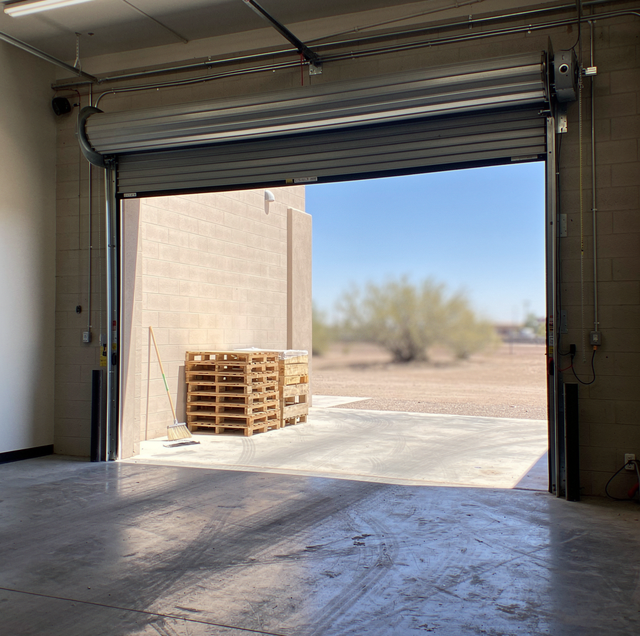
A commercial garage door earns its keep doing the same job over and over, every working day, so how it opens matters as much as how it looks once it's up. A roll-up door is a curtain of narrow, interlocking steel slats that stack and coil onto a barrel mounted above the opening. A sectional door is built from wide, rigid panels connected by hinges, riding on rollers inside a pair of tracks that carry it up and back along the ceiling instead of coiling it. That one difference in how each door stores itself, wound tight onto a barrel against folded flat back along the ceiling, is what drives every other decision: how much room the door needs overhead and behind the opening, how it seals against a conditioned bay, what a vehicle strike does to it, and how it holds up under heavy daily cycling. Lining up both doors factor by factor, from storage and overhead clearance to impact repair and upkeep, makes the tradeoff concrete before deciding what fits a given bay.
| Factor | Roll-Up Door | Sectional Door |
|---|---|---|
| Where it stores when open | Coils onto a barrel mounted above the opening | Stacks in horizontal sections that travel back along the ceiling on tracks |
| Space needed overhead and along the ceiling | Headroom above the opening for the barrel and operator, but little depth back into the building | Headroom for the curved track transition plus horizontal run space along the ceiling the panels travel into |
| How the counterbalance works | Torsion springs mounted inside the barrel counterbalance the curtain as it winds | Torsion or extension springs mounted on a shaft or along the horizontal track counterbalance the panel stack |
| Insulation and sealing | Double-wall steel curtain with foam between the layers on insulated models; seals run along the guide tracks and the floor | Foam-core sandwich panels between steel skins on insulated models; seals run at the jambs, header, and floor |
| Windows and light | Vision slats with small windows can be set into a curtain; no full glazed rows | Panel rows can include factory-glazed window inserts |
| What a vehicle strike damages | A bent or creased slat, which can bind against its neighbors as the curtain travels | A dented or bowed panel section, which can throw off hinge alignment at that joint |
| Upkeep under heavy daily use | Guide tracks, slat hinges, and the barrel bearing carry the repeated cycling | Rollers, panel hinges, and the track curve carry the repeated cycling |
| Fit for an opener | Runs on a barrel-mounted commercial operator matched to the curtain's coil weight | Runs on a trolley or jackshaft opener matched to the panel stack's travel |
Coil Versus Track: What Each Door Needs Overhead
A roll-up door's entire overhead requirement centers on the barrel: the curtain has to have somewhere to wind as it rises, so the space directly above the opening needs to stay clear for the barrel, its mounting brackets, and the operator who turns it. Because the curtain coils tightly rather than traveling back, a roll-up door requires little depth into the building behind the opening, which is one reason it fits a loading dock or a bay with a low ceiling close behind the header.
A sectional door asks for the opposite shape of clearance. The panels have to bend through a curved section of track where the door turns from vertical to horizontal, and that curve needs enough headroom above the opening to complete the turn before the panels can run flat. From there, the door needs horizontal clearance along the ceiling for the full height of the door when it lies flat, since the entire stack of panels has to fit somewhere once it's fully open. That horizontal run is where conflicts show up: overhead lighting fixtures, sprinkler heads, a ducted HVAC trunk, or an overhead crane rail can all sit in the path a sectional door's panels need, while a roll-up door's tighter coil clears that same overhead path. The two also lean on different structures to hold them up: a roll-up door's barrel and guide tracks mount to the wall around the opening and don't need a tie into the ceiling or roof framing, while a sectional door's horizontal track is hung from that ceiling or roof structure at its back end.
Insulation and Sealing for a Conditioned or Unconditioned Bay
Both door types come in insulated versions, with a foam layer that slows heat moving through the steel. A sectional door's insulated panels sandwich the foam between two steel skins across the full panel face, so the insulating layer runs edge to edge with no break. A double-wall roll-up curtain insulates the flat face of each slat, but the hook where one slat interlocks with the next is a thinner joint that carries less foam than the rest of the slat, so a roll-up curtain's overall insulating value can trail that of a sectional panel with comparable steel thickness.
Sealing works differently, too. A sectional door seals at the jambs on either side, along the header, and at the floor with a bottom seal, the same three points a residential door seals against. A roll-up door seals along the guide tracks that run the full height of the opening on both sides. Since the curtain's edges travel inside those tracks the whole time it's moving, there's also a seal at the floor where the bottom bar meets the slab. For a conditioned bay, whether that's a climate-controlled shop or a space that shares a wall with an office, the seal along the full length of a roll-up's guide tracks is worth checking as carefully as the bottom seal, since a gap anywhere along that run lets conditioned air escape the same way a gap at the bottom does.
Windows and Light in a Working Bay
A sectional door can carry a row of factory-glazed panels, letting daylight into the bay through the door itself without cutting into a wall. That matters in a shop where someone works near the door during the day, since natural light cuts how much the space depends on overhead fixtures during daylight hours. A roll-up curtain can take vision slats, individual slats with small windows cut into them, but not the broad glazed rows a sectional carries, so a bay behind a roll-up door takes its daylight from a wall window or a skylight, or relies on overhead lighting. For a storage building where an unobstructed view through the door isn't wanted anyway, that difference carries less weight.
Impact Damage and Repair
A vehicle strike hits the two door types differently because of how each one is built. On a roll-up door, a bent or creased slat can bind against the slats above and below it as the curtain travels, and a hard enough hit can knock the guide track it runs in out of alignment along with the slat itself. On a sectional door, a dented or bowed panel throws off the hinge alignment at that joint, which can cause the adjoining panel to bind as the door cycles through that section of track.
A door struck by a vehicle can hide a bent slat, a knocked-out guide, or unbalanced spring tension, and it can drop without warning. It stays out of service, with no one walking under it, until a technician checks it.
Neither problem gets better with the door left in daily use. A creased slat or a bowed panel concentrates stress at the point of the bend every time the door cycles, and the misalignment it causes at a hinge or a guide can load the parts next to it as well.
Springs and Heavy Daily Cycles
The springs on either door, wound inside a roll-up's barrel or on a sectional's shaft, hold stored tension along with the cables and drums they drive, and that hardware is technician-only work. A commercial bay that cycles a high number of times a day, whether it's a fleet garage, a loading dock, or a shop door in constant use, is a candidate for a higher-cycle-rated spring on either door type, the same tradeoff a high-cycle spring makes on any frequently used door. Where the two door types differ is which other parts carry that same daily load. On a roll-up door, the guide tracks and the slat hinges experience repeated wear with every cycle, as does the bearing the barrel turns on. On a sectional door, the rollers and the panel hinges wear with every trip, as does the load at the curved section of the track where the door changes direction.
The type of operator that drives the door, whether a barrel-mounted commercial operator on a roll-up or a trolley or jackshaft opener on a sectional, gets matched to whichever mechanism is chosen.
How the Choice Gets Made Bay by Bay
The decision comes down to what the specific bay offers and needs. A bay with a low header and little depth behind the opening, or one where an overhead crane rail or ductwork runs close to the ceiling, is a good fit for a roll-up door, since a standard sectional track has nowhere to run. A bay with clear ceiling depth, room for the track's curved transition, and a want for natural light through the door itself is a reasonable fit for a sectional door. A conditioned shop weighs sealing and insulation more heavily than an unconditioned storage building does, and a bay whose door runs all day weighs spring rating and hardware wear more than one used a handful of times. Measuring the opening against the headroom, ceiling depth, and side room each door needs settles the rest.
Frequently Asked Questions
It can take changes to the opening. A sectional door's track and spring mounts are built to fit the jambs and header as they currently sit, while a roll-up door needs a mounting surface above the opening wide enough for the barrel and clear structure to hang, with guide tracks running along the full height of both sides. Where the existing header or jambs cannot carry the barrel brackets and guides, they are built up or reframed first.
Endlocks, caps fastened to the ends of alternating slats, ride inside the guides and stop each slat from sliding sideways along its length. A worn or missing endlock lets a slat drift until its end catches the guide, and the curtain starts to bind on that side.
A sectional door locks with a slide bolt on an end panel that passes into a hole in the vertical track. A roll-up door locks with slide bolts on the bottom bar that engage slots in the guides, or with a padlock hasp at the bottom bar.
Not the same way. A bowed sectional panel binds at the hinges it shares with the panels above and below, and it can be replaced as a single section, with its hinges and roller hardware checked. A creased roll-up slat binds along the full width of the slats it interlocks with, and replacing it means sliding it out of the curtain between them.
It can, on a different track. A high-lift or vertical-lift track carries the panels up the wall before they turn, keeping the open door above a crane path or a vehicle lift, and a low-headroom track tightens the turn where space above the header is short. The track type is chosen with the door.
On a door built with perforated slats, yes. Those slats are punched with small holes across their face, so air and some light pass through the curtain while it stays down and locked. A curtain can mix perforated and solid slats.
Arrange a commercial garage door installation — a roll-up or sectional door matched to the bay's headroom, ceiling depth, and daily use. Phoenician Garage Door & Repair serves Phoenix and the Valley. ROC #316471. Call (602) 610-0112.